The Drive to Bratislava with a Stopover in Banská Štiavnica
On Wednesday of our second week in Slovakia, we finally left Podrečany for our now-standard trip to Bratislava. We decided to break up the long-ish roughly 2.5-hour drive by stopping in Banská Štiavnica to have lunch and ice cream, and piddle around the town's gorgeous historic center a bit. However, while Banská Štiavnica is technically located between Podrečany and Bratislava, it's still a little out of the way. But given that it's easily the most beautiful historic town in Slovakia, and the surrounding countryside is equally stunning and idyllic, it's worth the extra bit of time it takes to pass through there. (I've written about the town more extensively in this post.)
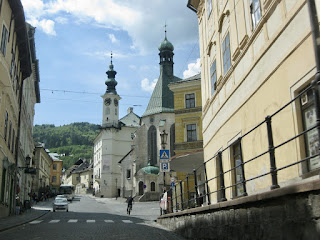
However, once we arrived, we wound up wasting a lot of time trying to figure out Banská Štiavnica's thoroughly confusing new parking scheme. On all previous visits to Banská Štiavnica, we'd just roll into town, find street parking right smack in the center - where parking always seemed to be ample and free - and enjoy our visit.
Nowadays, all street parking in the historic town center is marked with new text-heavy signs which essentially say that unless you're a resident, you can only park there for 30 minutes, and they monitor how long you've parked there via some computer chip that has apparently been placed inside everyone's cars. What's not conveyed at all on these signs is where you can park if you're not a resident and you want to park longer than 30 minutes.
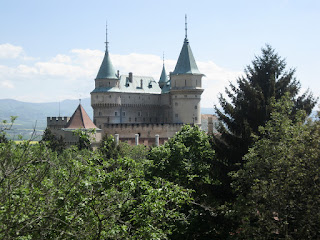
We learned that you now have to go to one of three designated paid public parking lots, two of which are located at the south-eastern end, down the hill from the old town, and a third sort of at the other end of the old town, high up the steep hill next to the Nový Zámok (the new castle). If you don't have cash to pay at these lots, you can download some app and pay via smartphone (though how you actually do this isn't explained at all). We only learned about the parking lots when Terezia decided to hop out of the car and go into a cafe to ask an employee how the hell this system works and where we can park.
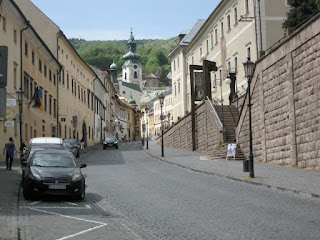
All three parking lots are located about one third to half a mile away from the central town square. Now, that's not a crazy distance, per se, but it's not exactly convenient either - especially with young kids in tow - as they all require a fair amount of hoofing it some distance up and down hills before you get to the very center of town. We chose the closer of the two lower lots. (All three lots had only a smattering of cars parked in them.)
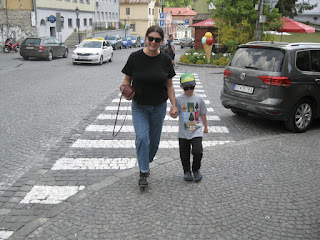
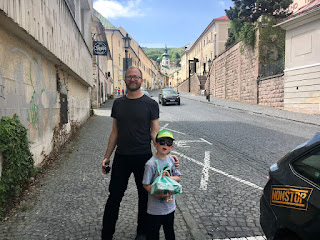
While Banská Štiavnica is unarguably one of Slovakia's most beautiful and picturesque historic towns, it's not generally crammed with tourists, like the mega-popular medieval hill towns of Tuscany or Provence. It's certainly popular, but it's too far off the beaten path to draw many foreign tourists, which make up a huge chunk of any town's tourism. We've been there at different times of the year and it's never been even remotely clogged with tourists, despite the odd tour bus group that comes through. So, while I'm sure the locals must've complained about some perceived lack of parking due to the day-trippers, it's hard to imagine that parking was ever truly that big of a problem (and indeed, on this day, there was ample street parking in the center), and these new designated parking lots are just far enough away to make visiting the place kind of a pain in the ass.
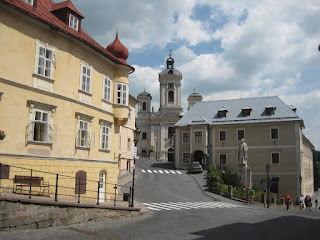
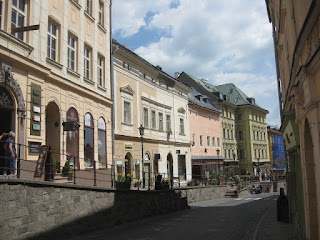
It's a little maddening to consider all the ways the town could've approached its supposed public parking conundrum that could have generated more revenue and been less of a kick in the pants for tourists and day-trippers.
For a brief recap: Banská Štiavnica was a hugely important and booming mining town for
centuries, but had become a desolate, forgotten backwater by the early
1900s when other more modern mining operations in the broader region
eclipsed it, and its own mines became depleted. Because it had lost all
its relevance by the time of communism, the communists never got around
to messing with it or modernizing it, so the town dodged a bullet, and
that's why it has remained one of the most perfectly intact historic
towns in the country. After communism, the town's people recognized the
value in what they had, so they faithfully restored it and transformed
it into the UNESCO World Heritage destination that it is today.
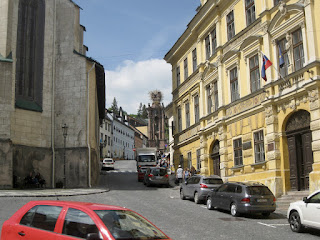
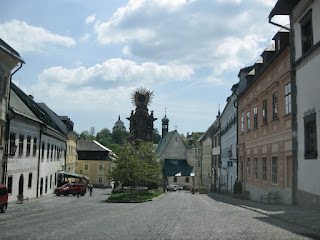
At any rate, we had a solid lunch at a mellow place called Penzión a Reštaurácia Kachelman, which had outdoor seating on a terrace overlooking the main drag. We then had some very tasty, if slightly overpriced, ice cream. But by the time we made it to the central town square with the elegant town hall and clock tower, Simon was already pooped from the walking, and we kinda needed to get back on the road, so we really didn't get to spend much time there.
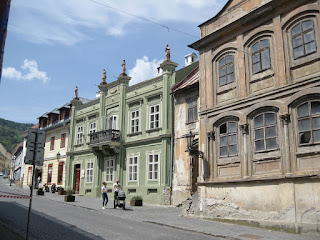
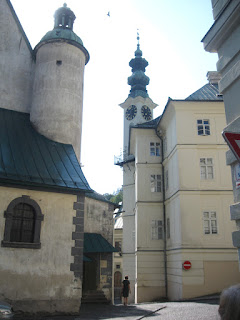
I realize nearly everything we've done on this trip has involved visiting towns and sites that we've already explored - and written about - but part of what makes this trip different is that Simon is now old enough to have some kind of understanding of the places we're visiting, and to make long-lasting memories of it all (he remembers nothing of our previous trips to Slovakia). What's cool is that he now points things out that I'm often pointing out. For example, we'll pass by some cool, old, ornate Gothic clock tower or church spire, and Simon will say, "Did you see that tower, Dad? Did you take a picture of it? Do you have your camera?" So, I don't know how much he's truly appreciating the value in these things, but it's cool that he's now noticing the things that I focus on and processing them.
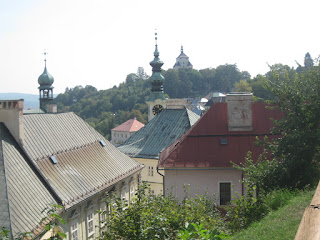
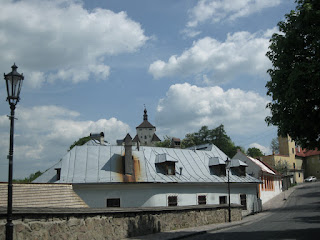
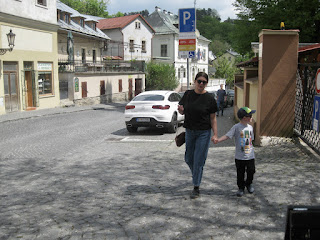
Banská Štiavnica really is one of the few historic towns in Slovakia that feel like you could be in some picturesque, old-world medieval hill town in Bavaria or France. That would be the perfect concept for the town's tourism campaign: "Hankering for a town in Slovakia that actually looks and feels like Europe rather than some drab, communist armpit? Come to Banská Štiavnica!"
Bratislava
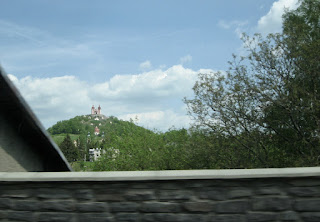
After Banská Štiavnica, we took a very scenic, green, and winding back road that goes through a large, dense forest and the old mining village Hodruša-Hámre, and eventually links up with the main R1 freeway (which heads west towards Bratislava) at Žarnovica. From there we continued on to our first destination in Bratislava: Terezia's cousin Ľudmila and her husband Christoph's flat in the Dlhé diely district of the city.
They live in a gorgeous, modern flat with cool views of both the cluttered city skyline and the soft, green (but punctuated by hundreds of wind turbines) Austrian countryside. (You can tell where Slovakia ends and Austria begins because Slovakia has no wind turbines.) They bought the place a few years ago, and it's spacious enough for them and their two daughters, aged five and one.
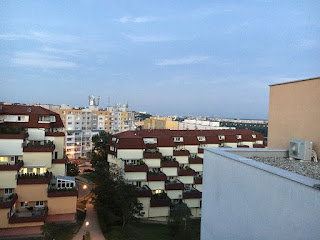 |
| The view from Ľudmila and Chris' flat towards Bratislava's old town. |
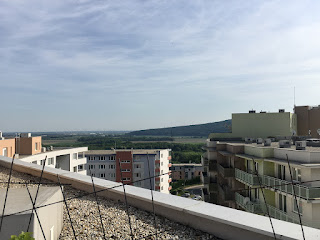 |
| The view from Ľudmila and Chris' flat towards Austria. |
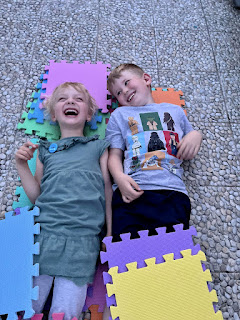
It was awesome to see Simon and Sasha (Ľudmila and Chris' older daughter) playing so nicely with each other. Sasha just turned five, so she and Simon are the same age. Even though they don't speak the same language (Sasha speaks Slovak and German, but knows only very limited English; Simon obviously speaks English, but his Slovak is very limited), they still had oodles of fun together, and they found their own ways to communicate with each other.
Simon has no cousins or family of any kind that are anywhere close to his age in the US, so it really means a lot to us to see Simon bonding so well and having such an awesome time playing with his cousins in Slovakia (Sasha is actually Simon's second cousin, but we're close enough with Ľudmila and Chris to simply refer to her as his cousin). We spent pretty much the entire evening at Ľudmila and Chris' flat on their spacious rooftop terrace, where Simon and Sasha had room to run around, play, and be totally silly together.
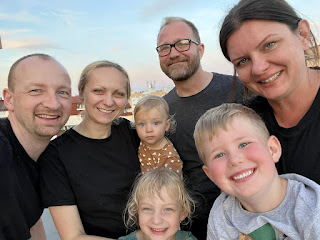
The weather has been quite warm for most of our stay, and it was warm enough for us to hang out with Ľudmila and Chris on their terrace late into the night. Their terrace has this total LA cocaine party vibe, and they told us the previous owner was a single middle-aged woman who was involved with fashion design, and was notorious for throwing wild all-night, drug-fueled parties. They said she was even known to find homeless people and random weirdos milling about in the neighborhood below and invite them up to her flat to do drugs.
After spending the night there, we got out early the next morning so Ľudmila and Christoph could work (not everyone's on vacation, obviously), and we did our now obligatory excursion into Bratislava's Staré Mesto, or old town.
This was the first time we strolled these streets with Simon without pushing him in a stroller (though he walked around quite a bit on the last trip), which was nice for a while, until his legs got tired and we had to drag him to the restaurant where we'd planned to have lunch - Bratislavský Meštiansky Pivovar - while he whined about it incessantly.
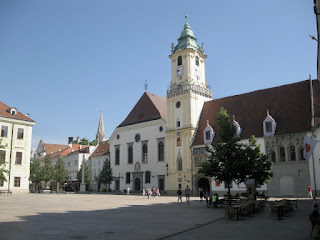
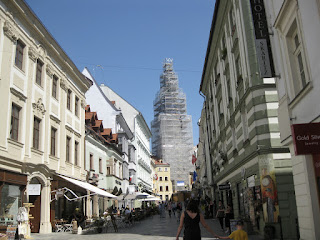
I'm happy to report that the scaffolding has been removed from the facade of the big Art Nouveau-style building in Bratislava's main square that caught on fire in a Christmas market mishap in 2018. However it used to more of a soft, pale yellow/cream color, and now it just appears to be white. Also, now St. Michael's Gate is completely covered in scaffolding, as it's currently undergoing some badly needed restoration work. It's such a major, defining monument for the city, though, that it's too bad they weren't able to at least cover the scaffolding with a blown-up image of the tower like they did for that building on the main square when it was being repaired.
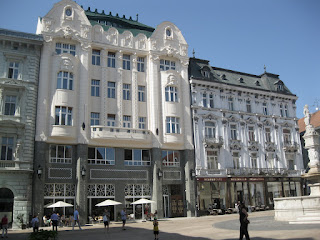
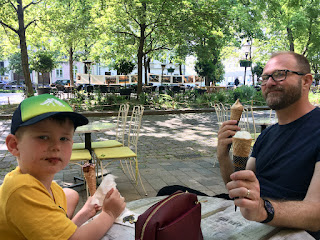
We had ice cream at Luculus on Hviesdoslavovo namestie, which is a bit overpriced (by Slovak standards) but quite good. I think Záhradná in Lučenec is still the ice cream shop to beat, though!
Simon insisted that we ride on one of the city trams, or električky, as they're called. He kept spotting them around the city as we were driving to and from Ludmila and Chris' place, and he quickly grew obsessed with riding one. The entire time we were ambling through the old town, Simon kept repeating, "I want to ride a tram. When can we ride the tram? Where do we find the tram? I want to ride the tram NOW! Let's go to the tram!" We eventually caught a tram at the Kapucínska stop at the northern end of the old town, and took it all the way down to the Miletička public food market, then hopped off and caught the same line going in the opposite direction. Simon never gets to ride on public transportation back home, so this kind of thing is super exciting for him.
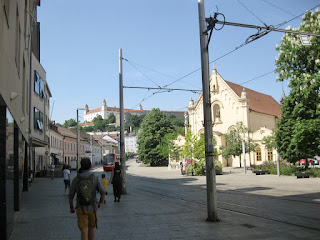
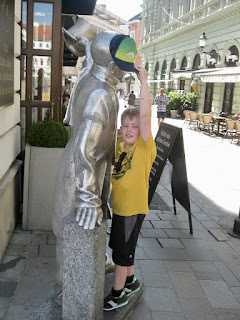
I've mentioned before how on past visits, we'd notice that certain shops or eating establishments that used to be there were empty or replaced by new ones, and this was still very much the case this time - perhaps even more so. We couldn't help but wonder if some of these places were casualties of the Covid lockdowns, since that obviously killed tourism for a while, which is the economic lifeblood of the old town. I noticed a few touristy gift shops and restaurants that had been around for years were emptied out and shuttered this time.
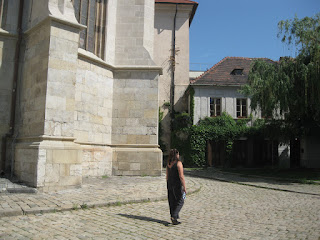
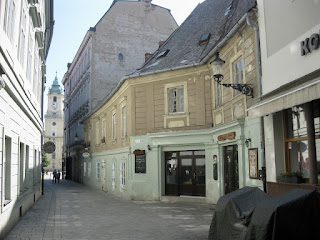
We always reminisce about our time in Bratislava when we stroll through these streets, and I honestly do miss the place. For all of its faults and quirks, which I wrote about ceaselessly and sometimes kind of caustically when we lived there, I do think I could live in Bratislava again someday - under the right conditions, of course. Terezia's not as sure if she could do it again, however, but she does miss the city sometimes, and we both have a lot of happy memories of living there.
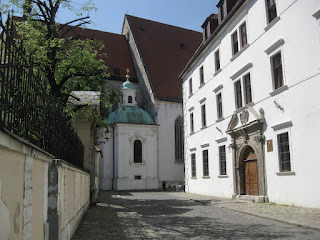
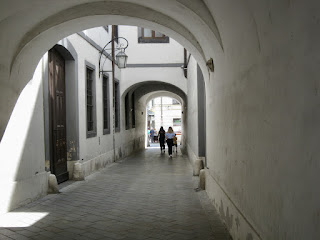
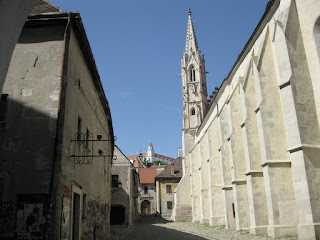
Lunch at Bratislavský Meštiansky Pivovar was not quite as great as last time, but this place still remains a cut above the rest of the restaurants in this part of town, and it's always packed at lunchtime. Try getting a table there even five minutes past 12:00 noon at your own peril!
I didn't manage to get any photos, but I did see several shops in downtown Bratislava with Ukrainian flags in their windows. This is a marked contrast with the Slovak countryside where I've seen scant evidence of support for Ukraine. Of course, when the war started, there were demonstrations in Bratislava and a few other towns against Russia's invasion, so you're naturally going to see more pro-Ukrainian sentiment in bigger, more metropolitan areas.
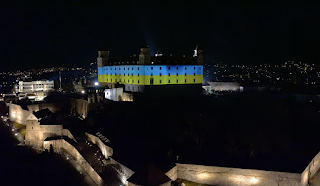 |
| Bratislava's castle lit up in the colors of the Ukrainian flag in late February, shortly after the invasion began. |
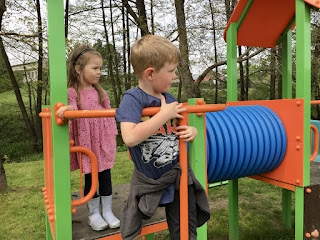
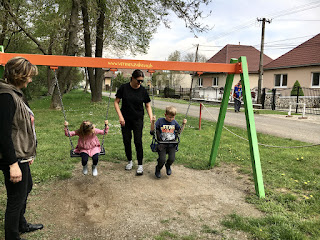
After lunch, Simon perked up quite a bit, so we stopped by the playground in Jakubovo námestie, which features a large, old-school communist-era play structure. Simon spent about 30 minutes climbing all over it and playing with some sand toys. This has to be the biggest play structure we've seen so far in Slovakia. The old-school communist aspect of it is kind of amusing because it lacks many of the safety features that modern-day play structures all tend to have. Simon is old enough and coordinated enough to handle it, but there are definitely some spots that could be problematic for slightly younger and less sure-footed kids, like the shaky bridge that's set at an almost vertical angle so that you have to climb it like a ladder. You can spot the old communist play structures right away because they're often made from wood beams and slats which are painted in the exact same bright primary colors.
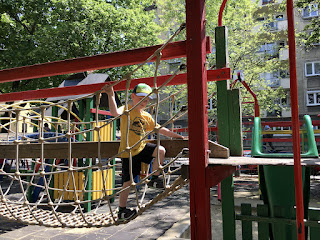
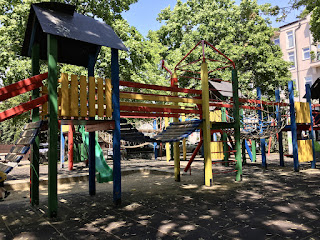 |
| All the old-school communist play structures are painted in the same basic primary colors, and are often made largely of wood. You don't see quite as many of them as you used to, so spotting one in a park is becoming somewhat of a novelty. |
From there we drove to Tony's house in the vibrant, bustling cultural hotspot of Bernolákovo.
Bernolákovo
I won't bore you again with all the details of the rapidly expanding yet still quiet and humdrum suburban town of Bernolákovo. It's just that I continue to be bemused by the town council's apparent failure to keep up with its crazy pace of growth. Last time I mentioned that the population boom had put such a strain on the town's schools that they had to add a bunch of modular containers to accommodate all the additional students. And the fact that the town still only has a total of maybe six restaurants and/or pubs is utterly bizarre.
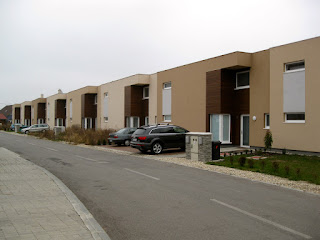 |
| Old photo of a street in a riveting, newer subdivision of Bernolákovo, circa 2011. |
On our first night in Bernolákovo, I met up with my British expat friend James. I feel bad because I always end up making him trek out from Bratislava via bus or train to meet in some dingy restaurant/pub in Bernolákovo. He says he's happy to do it, but at some point I'm going to need to overcome my fear of navigating the confusing regional bus system by myself. This time we went to the El Camino Pub and Restaurant, located at the center of "downtown" Bernolákovo's wild, pulsating nightlife. El Camino has a large, shaded, outdoor terrace - perfect for that evening's still-warm weather after a day of temperatures in the mid-80s.
James got me up to speed on some of the recent political developments in Slovakia. In my previous post, I wrote about the troubling attitudes of some Slovaks about the war in Ukraine and Ukrainian refugees. James explained that all of these petty grievances (refugees allegedly getting preferential treatment, people being outraged over the price hike of flour, food, and gas as a result of the war, etc.) are simply oft-repeated talking points by Robert Fico and his Smer party, which people just seem to be regurgitating. Fico knows these grievances (most of which aren't grounded in reality) will resonate with a sizable portion of voters, so he's stoking their misplaced resentment to get his party back in power. (Smer is currently in the opposition in parliament and not the majority ruling coalition.)
But man, to take an utterly horrifying war started on the skimpiest of pretexts, and the plight of millions of displaced refugees, and trivialize them just to milk more votes out of miserable and selfish people is a sickening and deeply cynical move. But this is coming from a man who had the audacity to recently call Ukrainian President Zelensky a liar and claim that he is "harming Slovakia's national interests," so it shouldn't be surprising.
The thing is, as James pointed out, Slovakia has a generally free press which reports on the war in Ukraine each day like most other Western countries. So, how can one see all of that horrific death and destruction on the television every day and yet feel more outraged by a price hike in flour or refugees with nicer cars? It suggests an alarming inability to imagine being in someone else's shoes, as another friend of mine recently noted.
Some of the more pro-Putin Slovaks seem to think that the US or Biden did "something" to piss Putin off, and so he decided to take it out on Ukraine. The problem is that, as James agreed, no one can offer a coherent or fact-based explanation of what the US supposedly did. Others seem to think Ukraine was on the verge of secretly joining NATO, but again, that's ridiculous. A lot of these anti-NATO narratives are pushed by Fico.
Fico is facing a trial over a number of charges pertaining to corruption and organized crime. This is part of a broader corruption crackdown that has led to charges for a number of big figures affiliated with Smer. Some people I spoke to are skeptical that Fico will be found guilty, but others hope this will be the thing that finally takes him down. He and his Smer party have no coherent or discernible political agenda; they just seem to want to stay in power, and they do so by tapping into the baseless fears and grievances of their voting base with a toxic blend of right-wing populism and nationalism. I'm just worried that if they do wind up back in power, Fico will go full-on Viktor Orban and try to make Slovakia more illiberal, corrupt, and Putin friendly, like Hungary. Fortunately, the next general election isn't until 2024, and right now both the Slovak PM Eduard Heger and President Zuzana Čaputová are proving to be good, smart, sensible leaders.
One reason it may appear to some Slovaks that some Ukrainian refugees drive "better cars" or are "too good" for jobs offered to them is obviously some of them are either affluent or at least have the means to abruptly go abroad. In countless news segments I've seen where a reporter is hunkered down with Ukrainians in a bomb shelter, the people are always asked why they didn't flee the country, and their answer is often that they didn't have the money or means to leave. I haven't seen any actual stats on this, but you're probably going to see a lot of smart, educated, highly skilled people with money fleeing the country, because they can, and this should go without saying, but they obviously shouldn't be any less worthy of help and sympathy than refugees with less money or fewer skills.
James knows a few people who have taken in refugees, including his girlfriend's family in eastern Slovakia, and he mentioned that some of them were offered money and even employment options, but they turned it down because they didn't need it; at that point, they simply needed a safe place to stay.
The other thing is that, as James pointed out, it would be in Slovakia's best interests to entice some of these refugees to stick around. They're getting a lot of smart, skilled, educated people from Ukraine who would be a boon to Slovakia's workforce and economy as employed, tax-paying residents.
More Bernolákovo (and Surrounding Environs)
We had a pretty low-key time with Tony in Bernolákovo. On Friday, after piddling around with the kids at a local playground, Tony took us to lunch at a restaurant called Furmanská krčma, located in the Carpathians on a forested, winding road above/beyond the town of Modra. With the place nearly empty except for a couple of burly guys slurping some hearty looking soup, I wasn't sure what to expect. The look of the place evoked the vibe of a cozy, rustic mountain chalet, from its log-cabin-style exterior and steep A-framed roof, to the misshapen wood burl tabletops, the wood-paneled walls, and the wood-beamed ceiling. With the weather up in the hills feeling 30 degrees cooler than down in the hot flat lands, the chalet vibe seemed fitting.
For some reason, a radio behind the counter with very poor static-laden reception was blasting some kind of talk show or interview so loudly that it was difficult to talk over it, so Tony politely asked the waiter to turn it down. The waiter, a tall, low-key guy in his 50s who seemed to be milling about looking for something to do, obliged despite seeming a little surprised by the request.
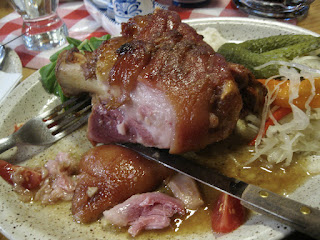
The food, however, was outstanding. I ordered one of the lunch menu deals - the pork knee - and this was indisputably better than a similar-sized one that I had in Paris back in 2014. Served on a massive bone and encrusted in a thick layer of crisped fat and collagen, the meat itself was mouthwateringly moist and tender, and the rich flavor packed a serious punch due to the perfectly aggressive seasoning. The portion looked massive, but once you removed the bone and cut away all the flavor-enriching fat, the actual edible pork wound up being a reasonable portion.
Terezia ordered the fried cheese, called vyprážaný syr, which is a staple Slovak and Czech comfort dish that she likes to get at least a few times whenever we're in Slovakia. Every restaurant in the country has it on the menu. It's frankly usually kind of blah, but when a restaurant does it well, it can actually be quite good. This place used a distinctively flavored smokey cheese, and the tartar sauce (which you're supposed to dip each bite in) was clearly homemade and perfectly seasoned. The fries on the side were nicely crisp and satisfying. This was a great example of vyprážaný syr done right.
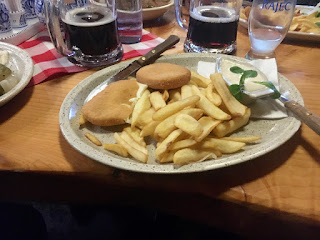 |
| Vyprážaný syr, or fried cheese. |
After we paid the bill, Terezia told the waiter that the pork knee was better than one we had in Paris, and he got a real kick of that. He even took the effort to say "thank you" and "goodbye" in English as we were leaving.
Two Strange Lakes
The next day Tony took us to two somewhat odd lakes: Zelená voda (which means green water), close to the Bratislava airport, and Slnečné jazerá (Sunny Lakes), in the town of Senec.
Getting to Zelená voda required driving about 1.3 miles down a rough dirt road, the entire length of which was an obstacle course of large, suspension-wearing potholes. We followed Tony in our rental car as he slowly and carefully snaked around the holes, while some impatient local behind us was riding our ass the entire time. Once there, the water was indeed quite green, but not in a majestic way—it was more just kind of swampy. We saw people in boats, several guys fishing, and a few people sunbathing on the shore, but no one was swimming (the water seemed a bit too murky for that). There was an outdoor "bufet," which served beverages and some food, with lots of outdoor tables and a small adjacent playground.
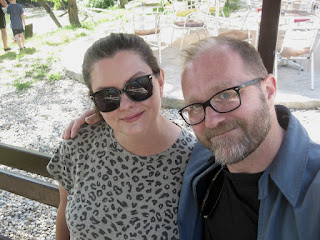 |
| Hanging out at Zelená voda. |
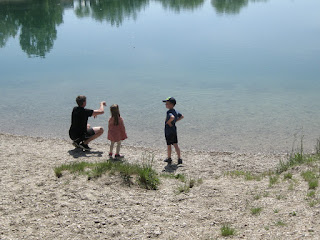 |
| Throwing rocks into Zelená voda. The water doesn't look as green in this photo. You don't see the sunbathing couple just out of frame, to the left of Tony, looking like their mellow has been harshed by the two little kids who came barging down to the lake to throw rocks into it. |
Slnečné jazerá was strange in a totally different way. It's located in the town of Senec, not outside it - it's not nestled in some gorgeous, pristine natural setting. About 75 percent of the lake's shoreline is spitting distance from a large industrial complex, busy major roads, a mid-sized train station, and lots of suburban sprawl, while maybe a quarter of it backs up to flat, open crop fields. It's apparently a massively popular recreation area, and not just for swimming on warm summer days - people actually stay there overnight and even camp there. One corner of the shore is dotted with these ugly box-like rental cabins, which look like small, sad modular offices on construction sites with severe, prison-like iron bars over the windows. There's also a big grassy field for car camping.
Aside from three good-sized beaches, the rest of the shore is crammed with mostly affluent-looking lakefront homes. Some are older communist affairs, but many are sleek, new, and ultra modern; all sharp angles, white stucco, shiny chrome trim accents and railings, and lots of glass with multi-level outdoor terraces overlooking the lake, which look designed for all-night cocaine-fueled ragers. I'm told a mix of rich Bratislava yuppies and oligarchs/mafia types have been buying up the shore like mad and building these flashy weekend party homes. The lake is like a glorified puddle in a dreary small town, yet it's apparently considered a popular destination akin to Lake Tahoe (albeit a million times smaller). It's a peculiar scene.
We had an extremely mediocre lunch at a funky place there called Lobster, which has gone to great lengths to look like a quaint tropical island resort, complete with a fake pirate shipped docked at the outdoor dining area, and hut-like cabins for rent on a dock over the water. The ship was closed when we were there, but had tables inside and on top for dining on crowded summer days.
Unfortunately, I have no pictures of any of this!
The rest of our time was spent piddling around Tony's house. We spent a lot of time in his garage, located at the very back of his large backyard, because it was cooler there than on his sun-drenched back patio, and comfy too, since he'd moved an old Ikea couch out there.
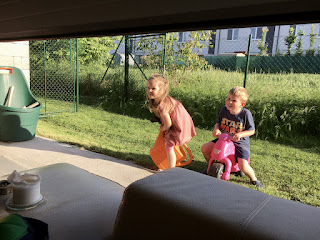
Again, it was lovely to watch Simon and his cousin Tea play so nicely together. As with Sasha, they don't really speak the same language (Tea speaks Slovak, obviously, but knows only a handful of English words and phrases, though she learned a new one - "What the hell?" - from Simon), but they still manage to communicate with each other. Tea had apparently been excitedly telling everyone in her preschool all week that her American cousin was coming to visit.
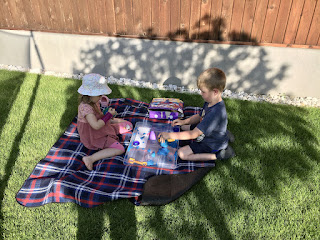
It's also nice that Simon, Sasha, and Tea are now at an age where they can play with and entertain each other with minimal adult supervision. That means they can play and do their thing near us or in a nearby room, while we can mostly relax, sip beverages, and chat uninterrupted. I really wish we could do more of this, for Simon's sake and ours. It kind of makes me wish we lived here again so that Simon could grow up close to family and cousins his age.
On Sunday morning, we left Bernolákovo and headed back to Podrečany.