Thursday, June 15, 2023

Trip to Slovakia, 2023: Part 1—Village Life, a Slovak Massage, Divín, and Slovak Views on Ukraine

We are back in Slovakia, yet again. Now that Simon is in public school, having just finished kindergarten, we are sadly confined to traveling abroad (or anywhere for any meaningful length of time) only during his summer vacation and winter break. It sucks because airfare typically costs more at those times, but it's not like we can just stop going. (I don't have anything really new and riveting to report yet, so feel free to go straight to my photos of this trip here, which I'll be adding to throughout the trip.)


Unlike the last three trips, when we flew in to Budapest and took a taxi straight to Terezia's mom's house in Podrečany, this time we flew to Vienna, where Terezia's brother, Tony, kindly picked us up and brought us to his house in Bernolákovo, just outside Bratislava. For some reason, this year flying to Budapest would have cost us $1,000 more (!) than usual, so Vienna it was.

After spending our first night exhausted at Tony's, Simon got up very early the next morning to play with his cousin/Tony's daughter, Tea (pronounced like Tay-ah), but also, we all got to meet—for the first time—Timotaj, Tony and Silvia's nine-month old son! He is devastatingly cute, but the poor kid has already been through hell and back on this dumpster fire of a planet, having caught both RSV and COVID over the winter. He recovered, but ever since he has had issues with his lungs with lingering bronchitis-type symptoms, which has meant numerous trips to the hospital and all sorts of medication and whatnot. Poor kid! The doctors say it will get better with time, but still, the experience was traumatizing for the whole family. I mean, imagine seeing your baby in the hospital hooked up to all sorts of tubes and breathing apparatuses.

Simon had a blast playing with Tea—they played together incredibly well, bouncing off the walls and darting around Tony's back yard and mellow neighborhood street out in front. Simon had said before the trip that he really missed his cousins (he even cried once about our near-total lack of family back in the States) and that he was very much looking forward to seeing them again.

We had to abandon our usual mafia-run (reportedly) car rental place in Lučenec because despite Terezia reserving a specific car from them online well ahead of time (an automatic Škoda Fabia wagon), they called a week before our trip to say they would only have stick shifts available, and Terezia really doesn't want to drive a stick (though she's totally capable of it). We managed to find a reputable place in Bratislava instead, which made more sense anyhow since this time we were going to Terezia's mom's place from there, but also, this agency had the added bonus of providing a free service where they brought the car to us, at Tony's house.

Back to Podrečany

We headed out for Podrečany at about 10:30 Saturday morning and made it to Terezia's mom's house in roughly two hours. The new stretches of freeway (er, dual carriageway) between Zvolen and Podrečany really help to cut the travel time down. 

Terezia's mom was, of course, overjoyed to see us, and she had lunch ready on the stove when we arrived, like most Slovak mothers would. It always feels like coming home here rather than being away.

By afternoon, Simon was already playing with Adamko, an autistic boy I mentioned from our last trip who lives next door and comes over to play. Simon and Adamko were racing up and down the street, with Simon on some child's bike that Tony found for him, and Adamko riding a scooter. The next day Simon met two more neighborhood boys, including Mirko from just down the street, whom Simon got on with instantly and played with every afternoon until he was completely wiped out. Mirko is a couple years older than Simon, but he seems like a really sweet kid, and he speaks English, so he and Simon can communicate pretty well!

We asked Mirko why we didn't see him around last year, and his response was really kind of sad: He said that last year he had a phone and that he was playing games on it all the time, but his dad had to take the phone to a pawn shop, so now he has to play outside. Sigh... You gotta remember these are some hardscrabble villages out here in this part of the country.

Mirko also thought we had just moved to Podrečany, like, to live here, and he was very sad to learn we're just visiting and we'll be gone in less than a month.

Unfortunately, in these first several days of the trip, I really have nothing exciting, different, or new to report. We've done the same sorts of things that we did at this point on the last few trips, so it's going to seem like déjà vu if I go through every stupid little thing in detail. So, I'll try to summarize this stuff in broad strokes.

Waiting for the train in Podrečany.
Ice cream at Záhradná.

Lunch in Lučenec.

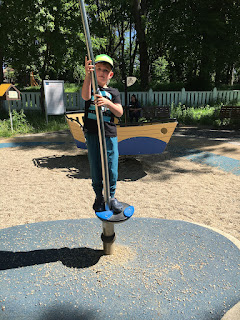
Simon in the park in Lučenec.

We've already been to nearby Lučenec multiple times to go grocery shopping at Tesco and to make necessary stops at the great Záhradná ice cream shop. We took the local train to see Terezia's dad's headstone at the cemetery in nearby Tomášovce, after which we got a loaf of that sublime, just-out-of-the-oven "tomorrow's bread" from the inconspicuous bakery there (which I first wrote about here). They're still not letting anyone inside their little shop (something they stopped doing back when COVID hit), but the two older ladies there happily let Simon come in, and he walked out of the place with six extra slices of fresh bread, in addition to our loaf, so it seems he was able to use his cuteness to his advantage. We had an hour to kill before the next train back to Podrečany, so we went to a pub that Terezia frequented as a teenager and had a beer while waiting for the train.


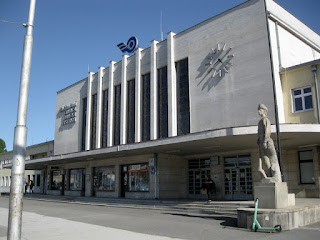
Waiting for the train at the still-breathtaking marvel of civil engineering that is the Tomášovce train station.

Simon outside the charmingly inconspicuous bakery in Tomášovce.

 
The view of the surrounding countryside seen from the cemetery when standing by Terezia's dad's headstone.

Killing time at a pub in Tomášovce.

I've also been getting my daily village walks in. There's not much news to report in Podrečany. The village's oldest building continues to crumble to dust unabated. Some of the locals still stubbornly refuse to use the sidewalks that were installed along the main street a few years ago. Sadly, one of Terezia's dad's old friends, named Ivo, who always used to say hello to me when I'd see him around the village, died in his sleep several weeks ago. A new stretch of freeway (er, dual carriageway) was completed since our last visit. Its exit by Podrečany is located just past the village if you're coming from the West. Fortunately, there seems to be just enough distance from the village that you can't really hear it, at least from Terezia's mom's street.


In the distance, you can see a section of the new freeway (sorry, dual carriageway) that runs by Podrečany.

Speaking of noise, on Tuesday morning we awoke at 6:15 to what sounded like a mad chorus of buzzing chainsaws not too far off in the distance. "Why in the hell are people operating chainsaws at 6:15 in the goddamn morning?" was my first thought. It wasn't until several hours later, when we were heading out to see the Divín castle ruin, that we saw three shirtless guys carrying weed whackers over their shoulders, walking away from the newly shorn grassy slope beneath the village's kultúrny dom that I realized it was, of course, weed whackers and not chainsaws, and they were likely trying to get it all done before the weather warmed up. Still, were we out-of-towners the only ones in the village who found doing this at 6:15 am puzzling? Chalk it up to village life, I guess.

I Got a Slovak Massage

My neck has been killing me for about nine months at the time of writing this. It's a sharp pain in the back of my neck at the base of my skull on the left side, and I feel it whenever I turn my head in either direction. I've already wasted money on a chiropractor back home, who did nothing to alleviate it, and I saw my doctor, who referred me for acupuncture, but they're so backed up that they had no appointments available until after our Slovakia trip. 

So, Terezia's mom suggested I go see her massage therapist in Lučenec, but there was a catch. You might recall from this post from our last trip that I mentioned Terezia's mom was getting massages from a guy in Lučenec who is very pro-Russia/Putin and anti-Ukraine/US/The West with regard to Russia's horrifying war on Ukraine. He believed that America somehow baited Russia into war (a BS argument that some people nevertheless buy into), and when Terezia's mom mentioned that her son-in-law and grandson were American, he let out a loud gasp and yanked his hands away in horror.

Anyhow, given that anecdote, I asked if this guy would really be OK with seeing me, and Terezia's mom said she talked to the guy and she insisted it would be fine. She scheduled back-to-back half-hour sessions for herself, me, and Terezia for our first Monday afternoon there. I was a wee bit nervous when entering the oppressively drab, communist-era multi-story office building, but the guy seemed to have no problem with me and was friendly and totally professional.

The communist-era building where the massage therapist has his office.

This massage guy is blind, and if it weren't for the milky coloring of his eyes, you'd never guess it, since he navigates his small office with ease. He is a big, beefy older fellow, with a low, booming voice and a slightly intimidating presence. First he had me take my shirt off and sit on his massage table with my back to him, and the second he laid his thick fingers on my shoulders, he let out a "Jesus!" (pronounced in Slovak like Yay-jheesh), because they felt so tight. He went to work on the muscles in my shoulders and around my shoulder blades, and gradually worked his way up. It felt great! For the second half of the session, he had me lie down on my back with my head resting on one of his knees, and he kneaded the problem areas in the back of my neck. Again, it felt awesome. 

Fortunately, the subject of the war in Ukraine never came up.

He strongly urged me to come back for more sessions, because he said the problem was severe enough that one session wouldn't be enough. I came back two days later and he focused more on my back and shoulders, saying I was insanely tight and that I had a terrible knot in my right shoulder above the collar bone. And the best part? The sessions cost a total of €10 each. No, that's not a typo—it's really ten euros.

Divín

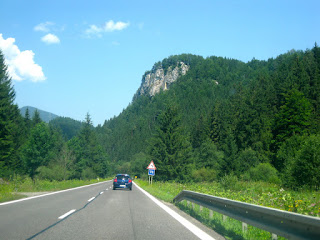
The road to Divín.

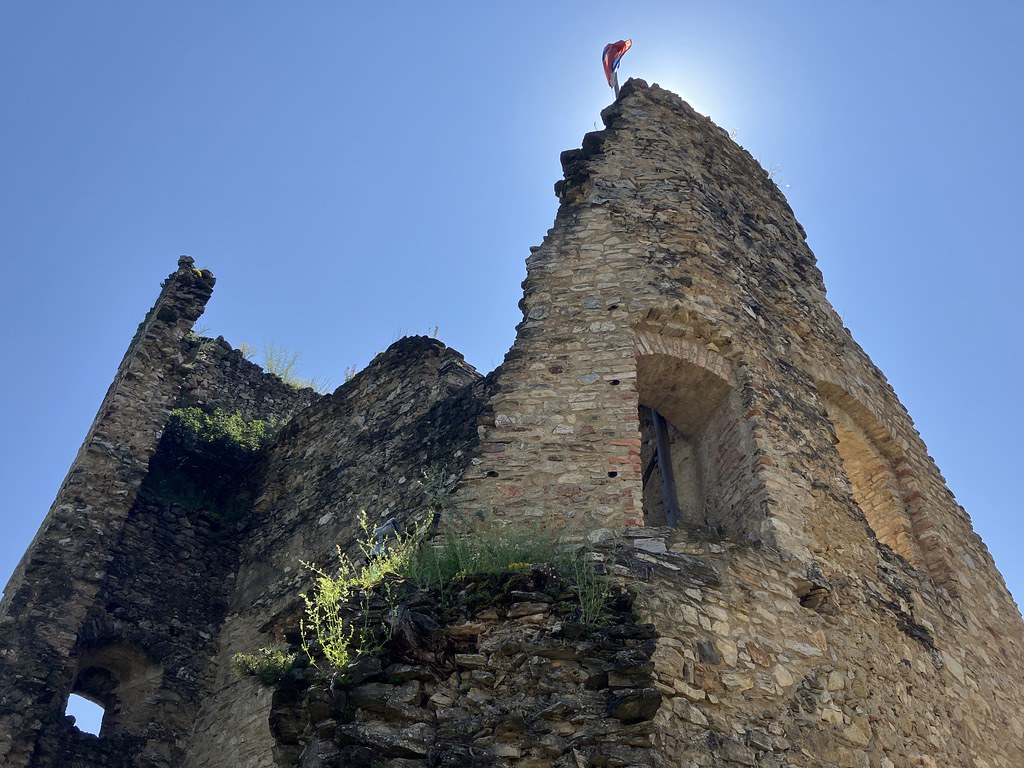
We made our by-now obligatory trip to nearby Divín castle, the evocative castle ruin I've mentioned here before, which overlooks the picturesque village of the same name, and the Ružiná reservoir and village just off in the distance. Each year as Simon gets older, he appreciates these kinds of things more and more and really takes them in, so it's worth returning to these places because of that. Plus, it's just a fun place to tromp around when there's not much else to do.


This time they had one of the more intact rooms made up vaguely like a dungeon, with a wooden table with iron shackles for the wrists, waist, and ankles, and a grate in the floor which, if you peered down into it with your iPhone's flashlight on, revealed a skeleton dangling from a string. EU-funded reconstruction work has been ongoing with this ruin for years, but this was the first time we actually saw a crew of workers onsite. This friendly woman who appeared to be their boss told us we were still free to roam the place and walk around the workers, but just to be careful. 


I've written about Divín and its history multiple times, so I'll spare you the repetition, but the ruins themselves and the views from atop the hill never get old for us. It really is a beautiful area and a nicer-than-average village.


 The Slovak People's Sadly Declining Support for Ukraine

Unfortunately, Russia's horrifying war against Ukraine rages on, but despite continued support from most countries throughout Europe to help Ukraine win, support in Slovakia has been slipping among its citizens.

Slovakia's government showed unwavering support throughout 2022, as its sensible, level-headed, and Western-oriented president, Zuzana Čaputová, and then-prime minister, Eduard Heger, were quite vocal about their desire to help Ukraine, and Slovakia took in hundreds of thousands of Ukrainian refugees. Slovakia also supplied what military aid it could to Ukraine; though peanuts compared to the US or UK, what they did provide was nevertheless a case of quality over quantity, including S-300 air defense systems and MiG-29 fighter jets, among other things.

However, the socially conservative Euro-skeptic Smer party, which perplexingly remains one of the most popular political parties in the country, has been highly critical of Western aid to Ukraine, and of NATO, from the get-go. Smer's leader, disgraced former prime minister Robert Fico, has long been known to have friendly ties with Vladimir Putin, and he has consistently spread disinformation and lies to make Slovaks wary of helping Ukraine. He has hammered out a message that the war is raising the costs of food and gas, that Ukrainian refugees are sucking up all the resources that should be going to Slovaks, and that helping Ukraine will somehow drag Slovakia directly into the war. This is all either misleading or outright bullshit, but that hasn't stopped a growing number of misinformed voters from buying into it.

According to Balkan Insight, "Among the [Slovaks] who expressed the most support for Russia in [a controversial 2022] survey were those who remain unvaccinated, support far-right parties or the former ruling party Smer, and are less educated," which is not at all surprising.

From the same article, information security expert Tomáš Kriššák said he is "not surprised by the declining support for Ukraine in such a polarized society as Slovakia's. The Slovak information space has been under the control of Russian propaganda spreaders for a long time, he noted."

Slovakia is said to be especially susceptible to the spread of Kremlin-propagated disinformation, as President Čaputová discusses in this interesting piece by Politico. Smer has also been playing the Trump card by claiming that the upcoming parliamentary election will be rigged by the state to keep Smer out of power, even though, as reported recently in the Slovak Spectator, "three top constitutional officials received intelligence which indicates that Russia harbors plans to manipulate elections in Slovakia to benefit Robert Fico's Smer party."

Compounding the situation, Slovakia's pro-Ukraine government collapsed in a no-confidence vote last fall, and while PM Heger continued to serve in a care-taking capacity until they hold elections, he resigned in May for reasons too complicated to get into here (no wrongdoing on his part, just a lot of strange, politically in-the-weeds circumstances). This has weakened the voice of pro-Ukrainian sentiment from the government, and Fico has been loudly filling the vacuum with Kremlin-approved propaganda ahead of the upcoming election.

The election is scheduled for September, and polls show Smer poised to make a comeback. That doesn't necessarily mean they'll win enough seats to form a ruling government coalition, but if they do, the fear is they will take a turn toward increased authoritarianism and kleptocracy, like Hungary's Viktor Orban, and cut off aid to Ukraine and realign the country with Putin/Russia.

Fico is a lot like Trump in that he is wildly corrupt and has a penchant for making inflammatory and brazenly dishonest statements. His party tends to be more about simply attaining and maintaining political power, and as such, they've never really had any coherent domestic or foreign policy, but they tend to be quite conservative on most political and social issues (pandering to their voter base), such as immigration, the EU, and now Ukraine.

Fico fell from power back in 2018, when thousands of Slovaks protested in the streets, demanding justice for the murder of journalist Ján Kuciak and his fiancee, Martina Kušnírová, as well as consequences for Fico and his party due to their inability to find and convict the murderer(s), and for their ties to the world of organized crime that Kuciak was investigating at the time of his murder. Yet, now, if the polls are to be believed, Fico and Smer are well-positioned for a comeback. Slovaks seem to have an infuriatingly short political memory. And like Trump, Fico just won't go away, and so far he has faced no legal consequences (he avoided going to jail after Slovakia's parliament in 2022 failed to approve a motion to suspend his immunity while he was under investigation for organized crime charges.)

We'll see what happens, but as is often the case in Slovak politics, there is ample reason to be pessimistic, and if things don't actually turn out for the worst, it'll be a surprise that no one saw coming. 


Monday, May 30, 2022

Yet Another Trip to Slovakia, Part 6: Final Post of the Trip

 
Sadly, the trip has ended, and we actually arrived back in the States about four days before I was able to complete this final post. This was the longest period of time we've spent in Slovakia since living there from 2011 - 2014, and overall I'd say the extra time was worth it. However, while Simon generally had a wonderful time, there were certainly a number of occasions when we felt he really needed to get back to school and his normal day-to-day routine. We never really got any "alone" time, if that makes sense (not even a date night), and we certainly all got on each other's nerves now and then.

Sorry for recycling this picture; I thought it turned out nice.

Sitting around a fire in Terezia's mom's backyard, grilling špekačka (like a fat, short, pork-based hotdog).

We didn't do a whole lot during our last week or so in Slovakia, so there's not much to report. We spent a lot of time with family the last weekend, as Tony, his very pregnant wife Silvia, and their daughter Tea, came and stayed at Terezia's mom's house, and we had a sort of lunch/memorial/get-together in honor of Terezia's dad at a nice restaurant in Lučenec called Biela Labuť, since we were unable to be in Slovakia for his funeral in late December. Terezia's uncle and aunt came too, as well as their daughter L'udmila, her husband Chris, and their two daughters.

Some photo collages of Tono that Terezia and her mom put together for the memorial/lunch/get-together we had at Biela Labuť on our last weekend there.

It was, of course, nice to spend so much time in the beautiful Slovak countryside. I feel my photos often don't do it justice. Sometimes I'm really struck by the beauty of the landscape, especially when the sunlight reflecting on it is just right.

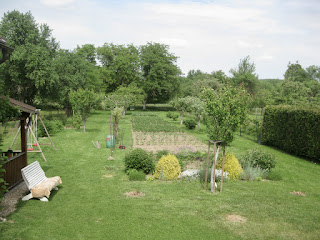
What a difference a month makes! Compare this shot of Terezia's mom's backyard and garden, taken in the end of April, with the photo below taken in late May.

Terezia's mom's backyard and garden at the end of May, one month later. The potatoes, in particular, have really taken off.

Simon did significantly better adjusting to the time difference and getting over the jet lag this time around. We only had one night (the second night) when he woke up at midnight and stayed awake until four in the morning. After that, he did great and slept through the night, every night. On prior trips, it would take three or four hellish nights for his internal clock to adjust. Now that we're back, we're obviously dealing with the jet lag again, and for us, the adjustment is always a million times harder after returning from Europe than when arriving there. On our first two nights back, Simon and Terezia crashed involuntarily around seven in the evening and woke up at two or three in the morning. The third night was a little better. It's going to be a rough week!
The grocery shopping chain Lidl has these small shopping carts for little kids. Simon doesn't understand why none of the other grocery stores have them.

When we left Terezia's mom's place in the taxi (to take us to the hotel next to the Budapest airport; we were flying out early the next morning), Simon cried hard for the first half hour of the drive. We kept warning him in the days leading up to our departure that we were leaving, but I don't think it really hit him until the moment the taxi pulled out of the driveway and started driving away (and, of course, this was right after Terezia and her mom sobbed uncontrollably while hugging goodbye). I haven't seen him cry that hard and for that long in a while, and he never did that when leaving on previous visits when he was younger. So, he's finally at an age where he truly understood where he was and appreciated it; it made a lasting impression that will probably remain etched in his memory. He really loved his time in Slovakia, especially with his grandma/starka, his cousins Sasha and Tea, and his uncle Tony, who is really good with kids. He loved doing "farm work" in Terezia's mom's yard, as well as having such a big yard to mess around in. I think he also really loved the attention and affection he got from Terezia's mom.

The long trans-Atlantic flight back home felt fairly grueling, particularly since Simon decided he was not interested in any of the activities we brought on the plane for him, like Star Wars coloring books, a mini Play-Doh set, etc., nor in the big selection of in-flight kids movies. Once we arrived, we got a Lyft driver to get us back home from the airport. During the ride, when sitting in San Francisco rush-hour traffic that was backed up like a Slovak klobasa in the colon, I was hit with feeling massively unexcited about returning to the Bay versus the rush I feel when being in Europe. I was happy to be getting back to the comfort of our home, but bummed out about being back in the Bay.

Overall, it was a good trip. Each trip with Simon gets a little easier as he gets older, obviously, but challenges still arise (he's only five, after all), and we both still deeply miss and yearn for the kind of trips we used to take before we had him. We're hoping in a few years Simon will be old enough to leave him with Terezia's mom, even for just three days/nights, so we can take a short trip to Prague or something. But, of course, the older he gets, the easier it will be to take him to different places. I just hope we don't have to wait another two and a half years before we can go back to Slovakia again. Assuming we don't have another global pandemic in the next year, that shouldn't be a problem.
Battle of the Cukráreň

Just across the side street from the Záhradná ice cream shop in Lučenec is a cukráreň, or patisserie, that is about as close to a literal hole in the wall as you can get. Simple, no-frills signage marks the entrance, located a dozen or so steps down the street from the main road. Once you enter the doorway that's low enough to warrant a strip of yellow and black striped hazard tape along the top of the door jamb, you immediately descend a couple of steps into a tiny space with standing room for about four people, bare white walls, harsh bright lighting, and three glass display cases with shelves loaded with pastries and some savory baked items. Middle-aged women who look like they've been up since before dawn emerge from a larger back room to help you.

The shop's extremely wordy name is Domáce kysnuté knedle, Škvarkové pagáče, a iné domáce pekárenské výrobky (in English: Homemade yeast dumplings, pork crackling biscuits, and other homemade baked goods), which reads more like a list of offerings than a short, snappy, memorable shop name. (It's also a slightly misleading name in that it refers more to the savory products they sell, even though those are significantly outnumbered by the sweet pastries they offer in their display cases.)

The hole-in-the-wall cukráreň in Lučenec.

We noticed this place when going to Záhradná, so we decided to check it out. We initially bought some pagáče (essentially like flaky American-style biscuits, often with pork cracklings sprinkled on top and/or woven into the dough), one of the savory items they sell, and they were quite good. We came back to buy some pastries, and these were mostly excellent.

I'm by no means an expert on Slovak pastries, but I've tried them a number of times over the years, and I can say that the pastries that this shop makes were really good, freshly baked, and flavorful. Many of these traditional Slovak pastries involve cream, some more than others, as well as layers of oozing custard, creamy textured chocolate, sweet pastes made from ground nuts, cake layers soaked in honey or coffee, and many other varieties.

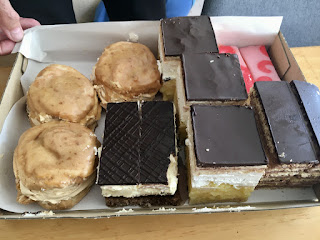
Excellent pastries from the hole-in-the-wall cukráreň in Lučenec. We got this big box of 'em when Tony and his family came to stay at Terezia's mom's place for a weekend. I can't remember the names of most of these, but the three things on the left that look like glazed cream burgers are called veterník, and they're one of my favorites.

When Terezia was getting a facial from the woman in Lučenec (the one who believes Ukrainian refugees are getting preferential treatment), she mentioned this cukráreň to her to see if she knew about it. The woman said she did, but she claimed to know of an "even better" cukráreň called Maggie's Cakes, across town by the synagogue. So, Terezia and I dutifully checked it out.

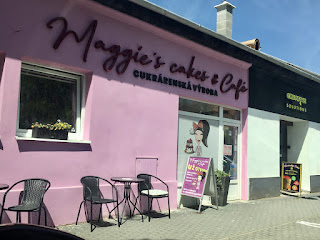
Unlike the hole-in-the-wall quasi-basement space occupied by the first place, this other cukráreň inhabits a ground-level space in a small building (which it shares with one other business) with a hard-to-miss pink shopfront. The owner appears to have spent a lot of money and energy on the look of the place, with its pink color scheme, stylized lettering, and supposed-to-be-cute/whimsical illustrated branding of a young brunette with a pink bow holding a cake. The interior was similarly decked out in shades of pink, with random vintage knickknacks on display along the walls. It looks like the kind of independent cupcake shop or food truck that you'd see in the Bay Area that's run by some young, ambitious hipsters.

The hard-to-miss shopfront of the not-so-great cukráreň on the other side of town.

The selection, however, was severely limited, with only four different types of pastries available (compared to the dozen or more varieties available at the hole-in-the-wall place). What we bought tasted old, like they had been sitting around for a week or more. The dough part of the veterník was noticeably stale, like chomping down on cardboard, while the cream filling tasted like air. Terezia also picked a couple of classic liqueur-filled, phallus-shaped špic pastries, not because we like them, per se, but because their selection was so limited, there was nothing else to try. The look of sheer disgust on Simon's face when he bit into the špic and tasted the liqueur was priceless! When his taste buds registered the flavor, he immediately started flapping his arms around in panic, and I had to quickly grab some napkins that he could spit it out into.

Adding insult to injury, it was quite a bit more expensive than the hole in the wall. At the hole in the wall, on one occasion we bought about eight pastries, half a dozen pagáče, and half a dozen of these small garlic knot things, all for a total of 16 euros. At the pink place, we bought six pastries only, which tasted stale and old, and it cost 14 euros! 

Maybe we went to Maggie's on what happened to be a bad day, but all it takes is one bad day to make a paying customer not want to return. I mean, an establishment, especially one that serves food, really has one shot to make an impression on a customer, and if that first impression is bad, what can you do but opt to take your money elsewhere?

Needless to say, we went back to hole-in-the-wall place a few more times during our trip. What made me admire them even more was they admitted one item we wanted was a bit old, and they sold it at a discounted price. Maggie's sold us ancient pastries without uttering a single warning or apology. So, I'm glad we know of a good cukráreň.

Slovakia's Health System Absolutely Failed Terezia's Dad (but He Was Complicit, Too)

A few years ago on one of our previous trips to Slovakia, Terezia was up at some ungodly hour in the morning due to jet lag when she heard her dad in the kitchen having the nastiest coughing fit she'd ever heard. He was turning purple and struggling to breathe, as he was hacking and wheezing uncontrollably with his lungs emitting the death rattle of a lifelong smoker. Terezia got him to calm down a bit by making him some hot coffee, but he clearly needed medical attention, as he did not have a cold or anything. This was the result of smoking a pack a day for his entire adult life.

Diagnosed with obstructive pulmonary disease in 2019, he never really followed up on his condition, despite Terezia's mom trying and often failing to get him to go to the doctor. When he'd have these sorts of attacks and she did manage to get him to see the doctor, or in some cases even called emergency paramedics, each time he somehow managed to pull himself together just enough to appear healthy enough to essentially fool the doctors and paramedics into thinking he was okay. Terezia's mom, as a result, was sometimes accused of overreacting: "He just needs to get out and walk more," said one doctor, while a paramedic who came to their house on one occasion told her, "He's fine. Just go inside, put your feet up, and have a cup of coffee. You have nothing to worry about." Tono died about two weeks after that.

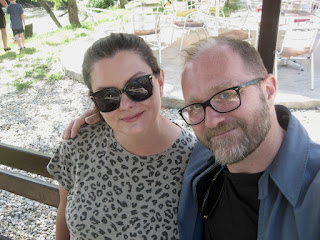
Such an attractive couple!

Doctors consistently blew off Terezia's mom's concerns. Of course, it didn't help at all when Tono would lie to the doctors and insist he was fine. But the doctors failed by merely taking Tono's word for it and not running further tests or doing any sort of follow-up with him. I mean, one did not have to spend more than a few minutes around Tono to see that he was not in good health. Doctors who were apparently too lazy to look into it further would dismiss Terezia's mom for "blowing things out or proportion." But then Terezia would get deeply upsetting reports about her dad from her weekly Skype chats with her mom, and each time we'd visit, Tono seemed to be getting worse.

It was recommended that Tono use inhalers that asthmatics (or borderline asthmatics like myself) use to open up their lungs and ease coughing fits, but he could not wrap his brain around how to use one. He kept just spraying it into his face. I even demonstrated how to use one a few times, and he still wasn't grasping it. There's an attachment you can buy for inhalers - usually for little kids - to make them easier to use, called a chamber. You stick the end of the inhaler into one end of it, and the other end is designed to fit snugly over your mouth and nose, and when you press the inhaler, the spray enters the chamber and you just inhale it through that. That way you don't have to worry about pressing down on the inhaler while taking a deep breath at the exact same second. Terezia was sending web links to her mom and her brother Tony so they could find a chamber, but I'm not sure if something was getting lost in translation or if they just couldn't locate one, but he never got an inhaler chamber, and so never used an inhaler. Why on earth a doctor couldn't have thought of this and helped them find one is mystifying. Again, no one seemed to be taking this seriously.

The drinking was also causing pretty significant problems with his brain. He had become pretty spacey and forgetful, prompting one specialist to speculate that he might have alcohol-induced dementia. But when trying to follow up on that, the chief neurologist in their area shot the idea down and then had the audacity to accuse Terezia's mom of gaslighting Tono by "filling his head with bullshit to make him think he's losing his mind." Yet again, here was a complete unwillingness to take the problem seriously, and it was apparently easier to be a misogynist pig and blame the wife.

Meanwhile, his drinking was also resulting in all sorts of frustrating and embarrassing problems which I won't get into here. And it got to where you could barely hold a conversation with him; he'd often mutter one-word responses, and interrupt you by asking for change for the pub.

Because of what a lifetime of drinking copious shots of hard liquor every day had apparently done to his brain cells, it's difficult to know if he was even cognizant of just how poor his health had become. Was he in denial about how bad he'd gotten, or was he even capable of realizing it in the first place?

Another issue Tono encountered, of course, was because of the Covid pandemic, hospitals were either filling up to capacity, or at risk of filling up, and that meant that hospitals and medical facilities often blew off anyone who didn't have severe Covid symptoms, which sometimes had tragic consequences. But, it must be said, if Tono himself had been honest about his ailments and proactive about following up, rather than using every inch of his strength to pretend that he was fine, he might have gotten more attention.

Either way, though I risk stating the obvious here, I feel it is incumbent upon medical professionals to be more proactive and take the kind of symptoms that Tono suffered seriously (and listen to spouses when they insist that something is wrong), because we feel that if someone actually had, Tono might have been around for a bit longer. 

Finally, I absolutely don't want this to be interpreted as a dismissal of Slovakia's entire health care system. When we lived there, most of our experiences with the health care system were positive or at least acceptable (though I certainly had a few negative and/or absurd experiences too), not to mention quite affordable. It's just that, for whatever reason, the doctors and medical professionals that Tono encountered in Lučenec mostly sucked.

Terezia HATES Slovak Drivers

Every time we're driving in Slovakia, we're instantly reminded of the difference between Slovak drivers and California drivers. Now, to be clear, California drivers have their own set of serious problems (mostly they are distracted and flaky [usually from messing with smartphones], they have a weird tendency to drive super slow in fast lanes and/or cut people off and then drive super slow in front of them, and speed up from behind on your left and (quite dangerously) cut you off when you're merging onto a freeway, etc.), so I don't want to pretend that we live in some paradise of perfect driving. But there's something noticeably distinctive about Slovak drivers, which really does make the experience of driving feel different in Slovakia.

The overarching problem is they tend to be extremely pushy, hyper-aggressive, and impatient. And Slovak drivers take the concept of driving directly on someone's ass - regardless of how fast you're going - to an entirely new level. I'm sure most Americans think everyone drives like this wherever it is that they live, but the aggressive and pushy driving truly is much more heightened compared to what we typically encounter in California.

A typical two-lane highway serving as a major artery in Slovakia.

Slovakia relies a lot on narrow two-lane highways and country roads for several of its major arteries, which means people will inevitably try to pass each other. This (over)reliance is due largely to the country's woefully still-incomplete system of multiple lane "freeways" to connect either end of the country (I'm revealing my California roots with the word "freeway"; the correct term is dual carriageway). So, you frequently end up in situations where you're stuck behind one or (likely) more slow-moving big-rig freight trucks, or sometimes even slower farm tractors, and the sections of road where it's safe and legal to pass are often maddeningly scarce and fleeting. As a result, passing is often necessary, but Slovaks take it to a new and sometimes dangerous level when they get impatient, which seems to be constantly.

For example, it's not uncommon to find yourself on a major two-lane highway stuck behind two or three slow-moving big rigs with half a dozen or so other cars in between (i.e., a veritable convoy of vehicles that would take forever to pass safely and legally in a leapfrog kind of way), and someone will be riding your rear bumper so closely that you can make out the color of their eyes in your rear-view mirror - as if you somehow could magically go faster or had somewhere you could go to let them by.

Another two-lane highway.

They may try to pass you - and however many other vehicles in front of you they can get away with - if they feel they have the opportunity, but there are times when an oncoming vehicle is suddenly approaching while someone is passing, and the person doing the passing suddenly has nowhere to go! In these instances, which we've witnessed several times, both the oncoming vehicle(s) and the cars or trucks in front of you that are being passed will all move as far to the right of the road as they can, creating a narrow corridor in the center of the road for the passer to drive through until he/she can shoehorn themselves back into their crowded lane. And no one is slowing down; this is often occurring at higher speeds. The first few times we saw this, I was certain I was about to witness a nasty and fatal head-on collision, but it was narrowly averted by this quick sort of dance.

But we see people passing when they shouldn't all the time, often at great risk to themselves and other drivers on the road, all just so they can get ahead of one car or truck, only to get stuck behind more slow-moving big rigs just up the road.

Naturally, you see a lot of makeshift crosses and shrines along the sides of Slovak highways, marking where people have died in car accidents, often from someone attempting to pass when they shouldn't have.

Slow trucks on a two-lane highway.

Another common phenomenon: When driving down any street and drivers are pulling up from a side street or parking lot to your right to turn onto your street, they always roll up super fast and then stop abruptly only after their front bumper is well into your lane in a way that honestly feels like they're not going to stop. You may think you see this in California or elsewhere in the States, but no - this is honestly different. It really feels like they're going to roll right out and cut you off or plow into you in a way I seldom actually encounter in California. They almost never do, of course; once you get attuned to the rhythm of Slovak driving, you realize they're usually not going to dangerously cut you off or plow into you. They're just aggressively and impatiently nudging themselves into the road as far and as fast as they can.

Slovak drivers do the same thing in roundabouts. Like other countries in Europe, Slovakia is filled with roundabouts, which are a safer and more efficient way to deal with intersections than four-way stops. When you're in a roundabout and you have the right of way, Slovak drivers approaching them on your right do so in a way that looks like they're going to barrel right into you - even big-rig trucks do this. They do ultimately stop, but if you show even the slightest hint of hesitation, some of them will just charge on through and cut you off, even if it means you have to slam on your brakes. Again, there's a certain rhythm to it that you have to get attuned to, but it can nevertheless feel unnerving.

Parking lots are another place where you can catch a glimpse into the dark soul of Slovak drivers. When you're crossing a parking lot to get to the store and you feel you have time to make it before the car approaching in the distance reaches you, it often feels like they're deliberately speeding up to nail you, as if they're playing some kind of game that involves driving over pedestrians for points. There's this very palpable feeling that they absolutely cannot wait that two extra seconds to get to the Tesco or wherever, and you are majorly inconveniencing them, so they're just going to mow you down.

Slovakia is a beautiful country.

In Senec, as we were following Tony to the Slnečné jazerá (lake), a woman made a left-hand turn into our lane directly in front of us, as if she didn't see us at all, very nearly plowing right into the front, driver-side fender of our rental car. Terezia reacted quickly and swerved around the right of the car, thereby passing her just as she realized what she'd done. But if it weren't for Terezia's lightning-fast reflexes, and the fact that we had space to the right of us to swerve around this woman, this could've been a nasty collision.

So, for these reasons, Terezia hates a large number of Slovak drivers, and I totally get where she's coming from.

Covid

A few weeks before we arrived in Slovakia in late April, the country abruptly ended all of its Covid-related mandates, such as wearing masks in all indoor public settings or places of work, and having to get weekly tests if you wanted to enter any indoor public spaces. They didn't ease the mandates, they just ended them abruptly and completely. I'm not sure if this was the wisest move, per se, as the country's vaccination rate stagnated at just over 50 percent (unfortunately, Slovakia experienced even more baseless and conspiracy-fueled vaccine resistance than the US). At any rate, by the time we showed up a few weeks later, people were going about their lives as if Covid had never happened. Pretty much NO ONE was wearing masks anywhere, save for the occasional elderly person in a grocery store or the odd foreign tourist entering an old church or something.

In the US, there have been three broad camps of attitudes towards masks during the pandemic: people who wear them seemingly everywhere all the time, even outdoors in situations where it's unnecessary (like walking down the street); people who refuse to wear them unless they're forced to; and people who fall somewhere in between, i.e., people who take it on a case by case basis and wear masks when entering a situation that's potentially higher risk, but not in places where the risk seems low. We fall into the latter camp of taking it on a case-by-case basis. Nearly every time we ate out on our trip, we sat outside, and on the few occasions when we ate indoors, either the place was nearly empty, and/or we weren't sitting in close proximity to anyone else, and/or we sat by open windows, all of which felt pretty low risk.

We tested for Covid a few times during the trip, including within 24 hours of our flight back to the US (as was required to enter the US at that time), and we kept testing negative, so either we were lucky or we were good at accurately assessing risk. Either way, I'm obviously relieved we didn't have to deal with Covid during or immediately after our trip.

Next Time

Hopefully, on our next trip, we'll be able to do more traveling or exploring. Tony mentioned the possibility of renting a big van and all of us going camping on the Croatian coast for a week. I'd also like to revisit Košice, as well as explore some of the High Tatras. You can take a gondola up to a platform at the top of the Lomnický štít peak, which is good way to experience the Tatras when you have little kids who aren't able to hike up it.    

At any rate, hopefully it won't be too long before we'll be back in Slovakia and I'll have more to write about here. To my dwindling audience, thank you for reading this blog and sticking with it! I'm sure some people thought (or wished) I'd have packed it in by now, but I'll continue to revive it when we travel in the future.

Click here to see all of the photos from this trip.

Sunday, May 22, 2022

Yet Another Trip to Slovakia, Part 5: Trips to Žilina and Banská Bystrica, and Simon Learns How to Ride a Bike

Continued from Part 4:

Day Trip to Žilina

Terezia's mom had the idea to take a day trip via train to Žilina. Anyone with any knowledge of Slovakia's geography knows that Žilina, up in the north-central part of the country, is not exactly a short, quick trip from Podrečany (in the south-central part of the country). And anyone who knows anything about Slovakia's cities or towns knows that Žilina is a far cry from the picturesque, atmospheric historic towns of Banská Štiavnica or Levoča. Based on photos I've seen of Žilina, I've never been particularly interested in going there, but when Terezia's mom suggested it, adding that you can get there via a scenic, hour-and-40-minute-long train ride that goes through 22 tunnels, we thought, "What the hell? Why not?"

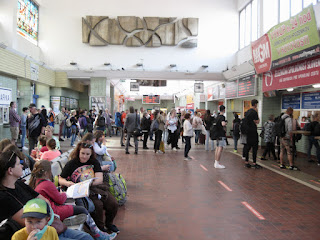
Banská Bystrica's austere, somewhat fascist-looking train station, completed in 1951.

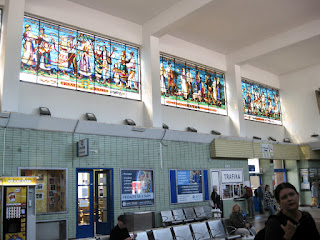
Stained glass windows inside Banská Bystrica's train station depict scenes of kroj-bedecked Slovak peasants and other traditional folk themes.

First, however, we had to drive to Banská Bystrica to catch the train there (since taking the train from Podrečany would involve two transfers and an additional hour and a half of travel time). The train takes you through gorgeous and dense forests, dramatically steep hills, and at times nearly vertical mountain terrain - as well as 20 of the 22 tunnels. You then descend into the southern end of the massive Turiec basin that leads north to the modern, industrial town of Martin. After taking a northwest turn through another range of steep, tree-covered hills, the train finally deposits you into the heavily industrialized valley around Žilina and the Váh river. 

Some village seen from the train.

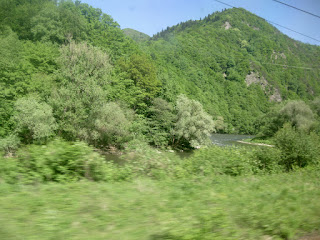
Stretches of the ride went through dense forests and rocky, mountainous terrain, but it was impossible to get non-blurry pictures of that from the moving train.

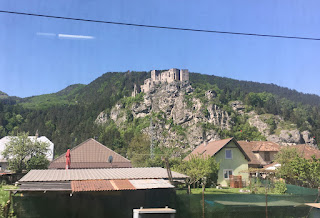
Shot of the mighty Strečno castle from the train.

Brief history: Žilina is the fourth largest city in Slovakia, with a population of more than 85,000. It got its start in the early 13th century as a Slavic trading settlement, and grew to become a significant hub of trade and commerce. It's been a major manufacturing center since the 1700s, with a booming garment industry and a chemical works emerging in the late 1800s. Today it's a city of heavy industry, including, notably, the sprawling Kia auto factory, which opened in 2004. Unfortunately, far-right Slovak nationalism has roots in Žilina: the racist rightwing scumbag politician Ján Slota was mayor of Žilina from 1990 - 2006. (Slota's extreme nationalist Slovak National Party was part of the ruling coalition in parliament with Robert Fico's Smer from 2006 - 2010.)

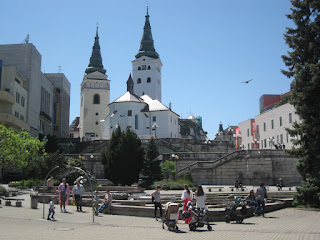
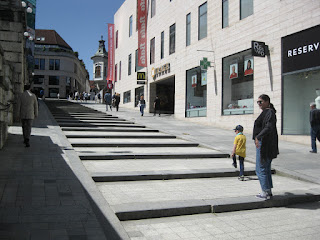
Anyway, when you exit Žilina's bustling train station, you're corralled onto Národná, a grand, tree-lined pedestrianized shopping boulevard. Národná takes you a few blocks up towards Hlinka square, a massive, round, communist-era public square whose focal point, directly across from where you enter it, is the rear-facing view of the historic Cathedral of the Holy Trinity, with its tall bell tower, and the adjacent Burian watchtower, both of which imposingly sit atop the edge of a raised area that's reachable by ascending either a series of zigzagging steps and platforms along the wall in the front, or a long, straight, shallow-stepped climb to the right. This is the money shot view of historic Žilina that adorns all of the city's tourist brochures and promotional material, and which inevitably accompanies any published write-ups of the town.

Národná, the broad major artery between the train station and Hlinka square.

The classic view of Zilina's old town from Hlinka square.

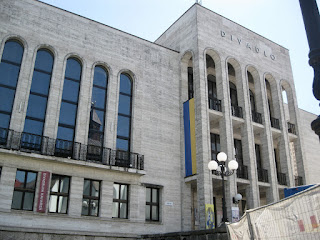
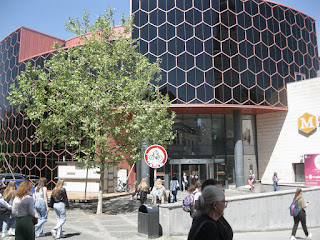
To the left of the church is the hulking travertine marble-encrusted Mestské Divadlo, the city's performing arts theater, which bears a striking resemblance to the kind of streamlined fascist architecture found in Rome's EUR district. To the right of the church is a big, ultra-modern shopping mall called Mirage with an entrance done up in a honeycomb pattern. These extreme contrasts are a defining characteristic of Žilina's old town.

The Mestské Divadlo (town theater) bears an odd resemblance to Benito Mussolini's EUR district in Rome (and its Palazzo della Civiltà Italiana). It's one of the most striking 20th-century theaters in the whole country, but definitely has that stark, streamlined look that both fascists and communists seemed to gravitate towards. Also, note the Ukrainian flag/banner down the side.

The contemporary Mirage shopping mall, adjacent to the old cathedral.

Once you pass the church, continue straight, down the crowded pedestrianized block to the right, to get to the central old town square, Mariánske námestie (St. Mary's square).

Facades on Mariánske námestie.

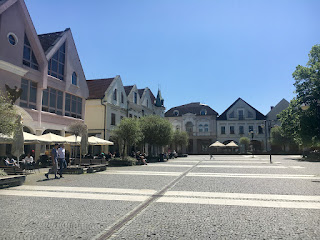
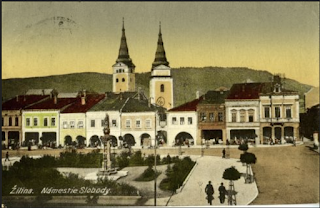
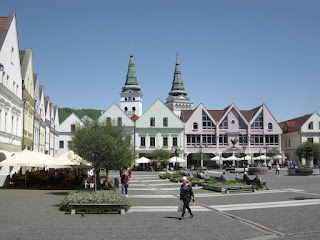
Mariánske námestie

Žilina's historic old town is minuscule, and even within this very small area, as much as 50 percent of the historic structures and facades appear to have either been radically reconstructed, streamlined, and stripped of ornamentation, or, in some cases, razed and replaced entirely. As a result, you have a somewhat jarring mishmash of historic styles and modern intrusion. Even Lučenec - yes freakin' Lučenec! - might have retained more of its ornate, historic Habsburg-era facades than Žilina. It is not the first city you'd want to visit if you love to marvel at remarkably intact, picturesque medieval or Renaissance town centers. 

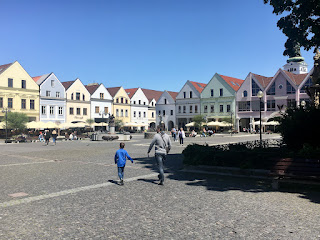
Mariánske námestie with some rather 1980s/90s-looking intrusion, courtesy of a big reconstruction project that occurred in the 90s (read on for more details).

As I mentioned, Žilina has a long history as an important industrial center and transportation hub in the north of Slovakia. Unlike Banská Štiavnica or Levoča, Žilina never lost its economic importance and languished as an irrelevant backwater. That means it never underwent a decline in population or economic activity, and over the years, the city council has continually adapted the urban landscape to suit whatever needs it had at any given time. Whereas Banská Štiavnica remained frozen in time since its importance waned in the late 1800s, Žilina has been subjected to continued redevelopment and modernization right up to the present. This means many of the city's historic buildings and facades have been heavily altered, erased, or destroyed.

Even on Národná, it's really only about every fourth facade that retains the original, ornate Habsburg-era style. In between you have facades that were given very plain, dull, streamlined makeovers.

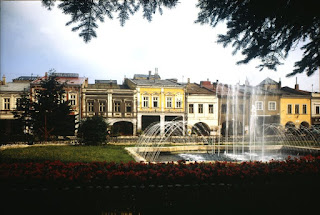
One of the weirdest things about the old town is the architecture in the main central square, Mariánske námestie. Nearly all the buildings are adorned with newly constructed, glistening, sharply pointed A-frame gables. A number of these gabled facades have almost none of the kind of ornamentation that buildings in Slovak historic centers almost always have, and several feature windows done in a style which looks quite oddly like something out of the 1980s or 90s.

Some of the central square's facades have had a curiously 1990s-looking makeover. The triple-gabled one in the center-right is obviously the worst offender, looking like something from an American strip mall or outdoor shopping plaza. Just put up a Ross or Petco sign to complete the look.

This blurb from the town website's history section offers some clues:

On December fifth [1997], St. Mary’s Square was returned to use after extensive reconstruction. Restoration took place from 1995 until 1997, and was preceded by archaeological research, which unfortunately could not be completed because of [the] quick process of construction. The town center received a new look . . . many houses underwent a comprehensive refurbishment. [Emphasis added.]

So, going by this, it seems that these puzzling, spartan and modern design touches were, in fact, a product of the 1990s, and as you can see, they very much look like something out of that decade or the previous one. It's a strange direction to go in when restoring a centuries-old historic center. Most towns try to faithfully restore them, but Žilina apparently had other ideas.


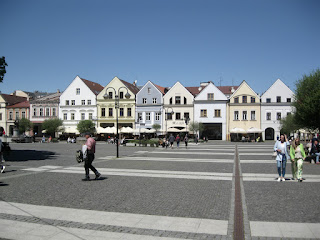
This row of facades on Mariánske námestie starts out looking nice enough on the left, but gradually gets more spartan and 80s/90s-ish as you scan to the right.

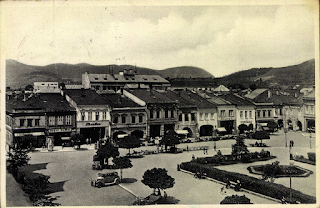
What's even weirder is I found numerous old postcards and photos online of Mariánske námestie from the 1930s and earlier, and almost none of the buildings at that time had gabled facades. I also found a few photos from the 1980s, and the buildings were still devoid of gables at that point. Furthermore, this style of gabled facade is not something you typically see in any of the historic town centers in Slovakia, with the very notable exception of Bardejov. So, who decided to give all of these facades gables with 80s/90s-style windows, and why?

Compare this old postcard with the image directly below. Do you see any gables here? Because at some point after this, all of these buildings sprouted gables, and some of them were given weird 80s/90s-style windows too.

Compare with above. What the hell happened? And whose idea was this?

Take a look at this 1930s-era photograph. No gables!

Here's a photo of this same row of facades as above from the 1980s: still no gables, and proof that these gables were added in the 90s. This raises the question: why in the hell did they decide to radically alter the look of the main square in the 90s by adding gables and A-framed roofs to nearly all the buildings? Why deviate from the original historic look?
I'm posting this current photo again of the same row of facades as the two photos above, so you can compare directly.

I suppose it's possible that in the Middle Ages all the burgher houses originally had gables, and maybe they ditched them in some later era after they (presumably) fell out of fashion? I haven't found any medieval-era paintings or illustrations of the square to see if this was the case, and the town's website doesn't mention anything about restoring burgher houses to their "original appearance"; only that the town center "received a new look." So, it's a bit of a head scratcher. Maybe they hired an architect who really likes Bardejov?

Despite this, while I'm not sure if Mariánske námestie is going to take anyone's breath away, if you squint a little, it all looks more or less cohesive and pleasant. It's objectively nice in that it's well maintained, and most of it looks decent enough, save for some of the most extreme 80s/90s-looking makeovers. The spacious square is very accessible, with an open, inviting feel and ample seating on benches. And, in fact, one important detail that sets this square apart are the arcaded/portico corridor walkways that line the entire perimeter, which is reminiscent of Bologna (which has portico walkways galore).


The old town hall, just left of center. Its upper facade is adorned with numerous bells, which apparently go off every hour, but I don't recall hearing them while we were there.

Locals were out in droves (by Slovak standards) when we were there, though these may have been lunchtime crowds. I saw almost no one who looked like a tourist. There were throngs of fashionably dressed teenagers and university-aged students darting in all directions; a number of 30-something professionals in sharp, sleek business attire on lunch breaks; some pensioners milling about; and a few small groups of homeless people having boisterous, slurred exchanges with one another. I have to say, the scene here was WAY more bustling than Prešov or even Levoča, where there was nary a soul to be found when we went.

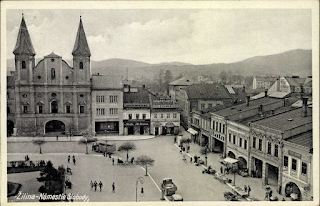
I'm sure the fact that this dominant building (the Conversion of St. Paul church and the adjacent monastery) was covered in scaffolding during our visit contributed to my somewhat downer take on Mariánske námestie as a whole. The square is probably a bit more striking when this thing isn't obscured by janky-looking scaffolding.

So, here's a picture of the church, circa 1930s, without the scaffolding.

Hanging out on Mariánske námestie's old well.

It's not uncommon in most Slovak towns with a gorgeous historic center to find that when you exit the main square in any direction, the historic buildings start to fade after a block or two and you see a sudden increase in architecture from more recent eras. Žilina's old town is an even more dramatic example of this phenomenon - you need only to walk a few doors away from the main square before seeing weird, modern intrusion. The sometimes tacky anything-goes signage of the shops adds to the visual noise.


We had lunch at a place on the corner of the main square with comically bad service: one server, who was the boss of the other servers, audibly chewed out her (very young) underlings for not doing their jobs well minutes after we were seated. The food took forever to arrive (very uncommon when ordering from the lunch specials menu), and when it finally did, they'd forgotten the soup (not serving soup before lunch in Slovakia is a capital offense). By that point, we'd been waiting so long that we thought, "Screw the soup," and dug straight in to the entrees. When the bill came, Terezia told the head server lady that we never got our soup, but she was unable to deduct it from the bill since the soup was automatically incorporated into the prices of the lunch special items. (Sigh...)

During the five years it took to receive our lunch (which tasted OK; we've had worse), we noticed a steady stream of happy people filtering through an ice cream shop a few doors down holding cones with generous scoops of nicely textured, colorful ice cream. This seemed like the place to go, so we went straight there after lunch. This was not your typical Slovak zmrzlina joint, however; they offered flavors that were akin to Ben and Jerry's, i.e., slightly exotic with chunks of brownies, cookies, fruit, and whatnot. But the actual flavors didn't live up to the appearance: I ordered two scoops: the Brownies and the Oreo Mint Cookie. The latter tasted like paste, while the Brownies was just OK - nothing at all like a typical flavor-packed pint of Ben and Jerry's.


After milling about the old town some more, we then slowly made our way back down to the train station for the ride back to Banská Bystrica. In typical Slovak railway fashion, they didn't announce the platform number that our train was to arrive on until the minute the train was actually arriving, which meant we had to endure a literal stampede of passengers who were all making a mad dash across the station for the platform.

Inside Žilina's bustling train station.

Žilina's train station also has stained glass windows depicting kroj-clad Slovak peasants.

I have to be brutally honest: I do not think that Žilina is really worth visiting. Unless you've got a peculiar obsession with Slovakia and you're trying to visit every city or town of consequence, or you like seeing bizarre hodgepodges of architectural styles with insensitive treatment of historic sections, there is little of any real significance to see or do in Žilina. There's no coherent sense of old-world atmosphere or stunning lanes of ornate facades or rustic stonework. While the surrounding natural setting, with steep, dramatic, forest-covered hills and the rushing Váh river, is quite beautiful, the city itself and the industrial and logistics center wasteland that surrounds it leave a lot to be desired. So, I really can't recommend the place. It might be a decent city to live in, but from a foreign tourist's perspective, it has nothing that I would go out of my way to see.

Day Trip to Banská Bystrica

Maybe it was because Žilina was such a predictable letdown; perhaps it was because our time was cut short in Banská Štiavnica from having to spend so much of it solving the mystery of the town's new parking system; and maybe it was because we had to leave Bratislava's old town earlier than planned due to Simon's legs getting tired from all the walking; but I was still yearning to spend just a little bit more time on this trip in some beautiful, ornate, intact historical center of any town that actually has one. So, on Friday we took a short day trip to Banská Bystrica, the closest town to Terezia's mom's village to fit that description.

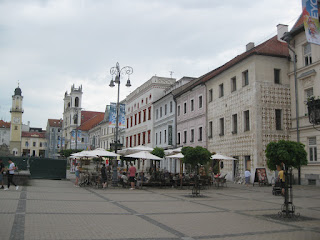
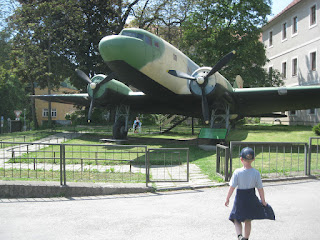
We drove to Banská Bystrica in the morning; ambled around and gawked at the vast, extremely picturesque, colorful central town square; took a gander at the old castle's gorgeous clock tower and cathedral; had a decent lunch at a place with outdoor seating on the square; ate the best ice cream we've found so far in Slovakia; swung by the SNP museum, where Simon checked out the old WWII-era military airplane, tanks, and train on display outside; then made our way back to the car, where we parked easily and for free just across the mighty Hron river and a couple blocks from the old town (take note, Banská Štiavnica!). It was a nice outing spent outside the village, and not in Lučenec, so I was content.

I did a pretty thorough write-up of Banská Bystrica in this post from 2014, so you can read that for more details. We also made a short visit there in 2019, which I wrote about here. I'd certainly give Banská Štiavnica the edge over Banská Bystrica in terms of overall beauty and atmosphere. I also have a soft spot for Levoča, and Kosice's historic center is hard to beat with its stunning gothic cathedral and lovely main square, but Banská Bystrica still ticks most of the boxes.


Brief history: Banská Bystrica, a small city (Slovakia's fifth largest) of ~78,000 inhabitants, is a relatively bustling urban area with a big university, several factories and wood processing plants, and of course, a striking and colorful historic town centered around a large main square. Nestled in a narrow, gently curving, forested valley along the Hron river, Banská Bystrica came to prominence in the middle ages as a copper mining town colonized by German miners. It has since come to hold a lot of symbolic importance in Slovak culture and history, due in part to its location in the middle of the country, but also because of its role in the Slovak national awakening in the 1800s and the Slovak National Uprising during World War II. 

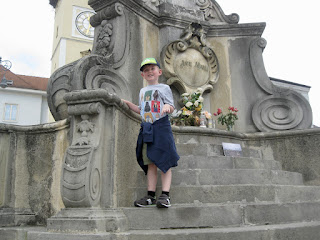
Simon has no memories of our previous trips to Slovakia, and therefore no recollection of the time we went to Banská Bystrica with him when he was two. But both then and now he was immediately drawn to the big fountain in the center of the main square. He also could not resist climbing the steep steps of the main square's plague column. An outdoor misting device had been set up on the square, which he gleefully ran through numerous times (though I think it's probably more useful on sweltering summer days).

We ate lunch at Reštaurácia u Richtára and ordered the mushroom cream soup, which had a nice wild mushroom flavor, and the duck, which was a decent leg and thigh in a slightly orange-flavored sauce, with a side of beautifully crisp fried potato wedges. The restaurant's men's restroom had these gorgeous medieval vaulted ceilings, which I was trying to point out to Simon (since he's starting to take notice of things that I tend to obsess over), but he was like "yeah, whatever," and was totally preoccupied with the little hand on the motion-sensor activated paper towel dispenser that flashes green when you wave your hand in front of it.


After lunch, we were going to head to what appeared to be a popular ice cream spot, right at the base of the slightly slanted clock tower at the top of the main square, but on the way there, we noticed another place, called Moja Srdcovca, whose ice cream looked too good to resist. I ordered a scoop of the pistachio nougat and a scoop of Belgian chocolate. This was the first ice cream we have found so far in Slovakia to clearly beat Záhradná in Lučenec. The Belgian chocolate was super rich and flavorful, like eating an actual chunk of quality chocolate, while the pistachio's flavor truly popped, and was possibly the best pistachio ice cream I've had outside of Italy. This place alone might be a reason to return to Banská Bystrica on future trips. I'm serious: Moja Srdcovca might be on par with Berthillon in Paris!

Moja Srdcovca: without question the best ice cream we've found so far in Slovakia.

Simon was interested in the old military plane outside the SNP museum. It's kind of stupid because you have to pay 50 euro cents per person to board it and the thing is very small (you'd struggle to spend more than a minute inside it), and you can't even go into the cockpit (you have to look at it from behind, at a distance of about 10 - 12 feet, through a plastic window). But when you're trying to entertain your young kid and maintain their interest, sometimes you have to suck it up. We actually went on this plane on our last trip when Simon was two, but as soon as we'd paid and went on board, Simon pooped in his diaper, so we immediately had to run out of there and make a dash for the car so we could change him. This time, he had to take a dump here again, but fortunately the guy at the front desk of the SNP museum let Terezia and Simon in for free to use their restroom.

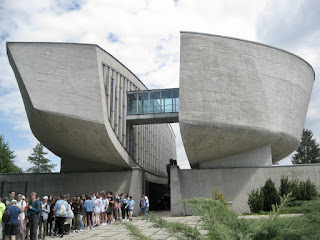
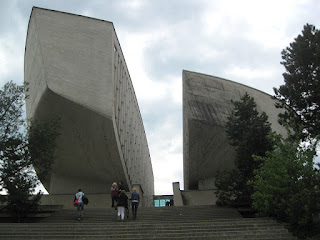
As I've mentioned in older posts, the SNP museum has to be one of the coolest examples of modern, 20th-century communist-era architecture in all of Slovakia.

School field trip to the SNP museum.

It's the end of the school year for many schools in Slovakia around this time, and we saw groups of teenage boys and girls dressed in formal prom-like attire, roving in packs around the town square loudly celebrating because they'd just graduated their equivalent of high school or specialty/trade school. They were going up and down the square singing boisterously (and perhaps drunkenly), sometimes accompanied by one of them playing an acoustic guitar or violin. This is apparently the traditional way to celebrate high school graduation here.

You can see a pack of male secondary school graduates just left of center in the lower third of this photo.

It felt nice to spend a little time basking in the old-world atmosphere. I just need a bit of that now and then, since we're unable to travel like we used to, because we now have a kid who is at an age where he's really incapable of traveling like we used to. I'm hoping in a couple of years we can leave him with Terezia's mom or Tony for a week and then take off for Prague or Florence, or wherever. Then, once he's in his early teens, he'll be at an age where he's able and willing to travel with us in a way that's similar to how we used to travel. 

Communist-era post office.

The Hron river in the center of the town.

Simon Has (Finally) Learned How to Ride a Bike!

For a few years now, Simon has been somewhat resistant to learning how to ride a bike, though that's not entirely his fault.

When he was three, we got him a balance bike. Balance bikes are small bikes with no pedals, designed to teach kids aged two (or younger) to three, how to balance themselves on a bike and coast by pushing themselves with their feet. Once they get the feel down, in theory, the transition to a regular bike with pedals is supposedly easier and comes more naturally. Balance bikes are now considered the new way to teach kids how to ride, and training wheels, though still common, have been falling out of favor. 

The problem is when Simon got his balance bike, he'd been riding tricycles for a while, and he was accustomed to having pedals, so his immediate reaction to the balance bike was, "Where are the pedals?" Because it had no pedals, he had zero use for it, and no matter how often we tried to get him to ride it, he steadfastly refused. Meanwhile, we'd go to any local playground and see kids half his size coasting around effortlessly on balance bikes.

The balance bike we got him had a pedal conversion kit for when kids are ready to pedal. I installed it, and that made him want to ride it more, but he was having a hard time balancing, and by the time we got the pedals on, he'd already outgrown the bike. We put some training wheels on it, which got him riding more, but as he was visibly outgrowing the bike, it was time to get a real bike that fit him.

The other problem is our neighborhood. We live on a steep hill, and while there are some level streets a block or so away, they're quite narrow and crammed with parked cars, and just not ideal for a kid who needs space to learn to cycle freely. So, whenever he wanted to practice cycling, we had to throw the bike in the car and drive to a park with flat, smooth, spacious concrete paths or areas for cycling.

We got him a good, new, well-rated bike for his fifth birthday in March, but he didn't seem interested in using it prior to our trip to Slovakia.

However, Tony happened to buy his daughter, Tea, a Woom bike. Woom bikes are Austrian made and universally acknowledged as the best kids bikes in existence. They are the lightest kids bikes on the market (the largest size weighs in at a remarkably light ~15 pounds), and they are specially designed to fit kids ergonomically. They get nothing but gushing praise from parents and bike experts. The problem is they run about $550 new - you're definitely paying for that ultra-light weight and ergonomic design. In Bratislava, every damn kid seems to have one.

(Kids bikes have long been known to be insanely heavy pieces of garbage that would be better used as boat anchors. Over the past decade or so, increasingly lightweight and better designed kids bikes have been coming on the market, but they are more expensive. Speaking as a longtime cyclist myself, I can attest to the massive difference it makes to ride a light, well-designed bike.)


Tea, who is four, has been riding a Woom pedal bike effortlessly since she was three, and she used the smaller Woom balance bike before that. Tony brought Tea's bike to Podrečany so that Simon could practice riding on it. Terezia's mom lives on a perfectly flat, long, well-paved, and extremely quiet street - the perfect place to learn how to ride.

Tony was the one who first got Simon out on the street, and he ran up and down the length of it alongside Simon while he pedaled. At first Simon was a little shaky and hesitant, but after going up and down the street with Tony a few times - only grabbing him when he looked like he was going to veer wildly off the road - Simon was able to ride with minimal assistance. We took turns running up and down the street with him until he was comfortable and steady enough to ride without needing to be grabbed or held at any point. After several more "laps," he no longer needed a little push to help him get going, and he was pedaling too fast for us to keep up when running alongside him.

Tea's Woom bike is the size 3 and Simon needs the size 4, but the Woom is so damn light and well designed that he's able to ride it pretty easily (and we can still raise the seat more to his height). The size 4 Woom is supposed to last until kids reach the age of 9 or 10 (or older, depending on how tall they are). 

We'll see how he does on his new bike when we get back home. It's a good, solid bike, but not as light as the Woom.

Some kids just seem to naturally have better balance at a younger age, and Tea is one of those kids. Not every kid masters a pedal bike with no training wheels at the age of three, like Tea did. I also believe (and have heard) that little kids who are very tall for their age, like Simon, also have a bit more trouble with balance and coordination (i.e., they're a bit clumsier). For example, I couldn't ride a bike until I was five, i.e., Simon's age, and I was also tall (though not as tall as Simon) and clumsy at that age. And L'udmila and Chris' older daughter, Sasha, who is also five and possibly even a hair taller than Simon, is still learning to cycle (she also has a Woom bike).

 At any rate, yay Simon!

 Click here to see all the photos of the trip so far.