...can be found here.
More updates and observations soon!
Wednesday, January 11, 2012

Sunday, January 8, 2012
An afternoon at the Slovak National Gallery, Bratislava
Now that we have the holidays and the residency permit ordeal behind us, we've finally had time to do some things that we've been wanting to do for a while, like check out Bratislava's Slovak National Gallery. The SNG is Bratislava's chief art museum, which in addition to a permanent collection consisting of Italian and Dutch paintings from the 1500-1800s, as well as a bunch of local gothic and baroque paintings and sculptures, seems to have a lot of temporary exhibits focusing more on modern art.
I'd been dying to see an exhibit there that's ending soon called, "Nove Slovensko - Difficult Birth of the Modern Lifestyle." The exhibit basically chronicles Slovakia from the immediate post-WWI years (when it became a new nation - no longer under Austro-Hungary's control), through the late 40s (when the Communists had taken the reins) via two floors of photographs, paintings, awesome Bauhaus/Constructivist poster art and graphic design, and even some sleek modernist furniture. This was an extremely fascinating, cool, and well-put-together exhibit, and I'm really glad we managed to catch it before it ends. And as a welcome bonus, the gallery was free today, as they offer free admission every first Sunday of the month.
There were some stunning paintings, like this one by Gejza Schiller:

And some incredible Constructivist/Bauhaus-ish posters, like this one:

There was also a beautiful, cubist/futurist style painting by an artist with a Hungarian last name that, for the life of me, I can't remember. The painting was called Paris Cafe, and was done in 1930. I've scoured Google and can't find any info on it. At any rate, it was great to see so many abstract paintings (many cubism-inspired) by artists I'd never heard of before.
The exhibit featured countless photographs of Bratislava during the decades covered in the exhibit, and it was fascinating to see how it looked back then. Some photos were very reminiscent of Rodchenko's angular, modernist approach, while others simply documented life during the decades represented. Through some of these photos, I learned that a few of the buildings in our neighborhood are older than I'd assumed. For example, I discovered that this building which I've photographed several times, called the Manderla building,

which is a block away from our apartment, was the first residential high-rise constructed in Bratislava, and it was built in 1935. I honestly thought it was from the late 40s, but I was off by over a decade. If the building still had the Manderla signage along the top, I'd probably have guessed its age more accurately.
There was also a wall that covered Slovakia's dark, hellish fascist phase, which lasted from the late 30s through early 1945. These photos showed scary rallies with the fascist paramilitary Hlinka Guard, basically Slovakia's blackshirts, who were responsible for forcibly deporting Jews, Roma, and dissidents. One photo showed Jews being "escorted" out of Slovak town Nitra by Hlinka thugs. Like much of Eastern Europe, Slovakia was an unrelentingly bad place to be during WWII if you were Jewish or Roma. (Interestingly, the Hlinka insignia, ubiquitous at that time on flags and armbands, has an eerie similarity to the one used by the fictitious fascist Norsefire regime in the film "V for Vendetta").
I also learned through several photos that, apparently, up until the 1930s, women from some rural areas of Slovakia were still wearing what can only be described as traditional, medieval peasant/folk garb. One such photo (circa mid-30s) showed a group of barefoot, young women dressed in full-on peasant attire, shoveling dirt to make way for train tracks. Other photos showed similarly dressed women selling produce or doing routine daily chores. The women in these photos really did not look like they were simply dressing up for some photo shoot intended to celebrate Slovakia's national heritage.
At any rate, it was such an impressive exhibit that if it weren't ending in less than a week, I'd probably go back.


I'd been dying to see an exhibit there that's ending soon called, "Nove Slovensko - Difficult Birth of the Modern Lifestyle." The exhibit basically chronicles Slovakia from the immediate post-WWI years (when it became a new nation - no longer under Austro-Hungary's control), through the late 40s (when the Communists had taken the reins) via two floors of photographs, paintings, awesome Bauhaus/Constructivist poster art and graphic design, and even some sleek modernist furniture. This was an extremely fascinating, cool, and well-put-together exhibit, and I'm really glad we managed to catch it before it ends. And as a welcome bonus, the gallery was free today, as they offer free admission every first Sunday of the month.
There were some stunning paintings, like this one by Gejza Schiller:

And some incredible Constructivist/Bauhaus-ish posters, like this one:

There was also a beautiful, cubist/futurist style painting by an artist with a Hungarian last name that, for the life of me, I can't remember. The painting was called Paris Cafe, and was done in 1930. I've scoured Google and can't find any info on it. At any rate, it was great to see so many abstract paintings (many cubism-inspired) by artists I'd never heard of before.
The exhibit featured countless photographs of Bratislava during the decades covered in the exhibit, and it was fascinating to see how it looked back then. Some photos were very reminiscent of Rodchenko's angular, modernist approach, while others simply documented life during the decades represented. Through some of these photos, I learned that a few of the buildings in our neighborhood are older than I'd assumed. For example, I discovered that this building which I've photographed several times, called the Manderla building,

 |
There was also a wall that covered Slovakia's dark, hellish fascist phase, which lasted from the late 30s through early 1945. These photos showed scary rallies with the fascist paramilitary Hlinka Guard, basically Slovakia's blackshirts, who were responsible for forcibly deporting Jews, Roma, and dissidents. One photo showed Jews being "escorted" out of Slovak town Nitra by Hlinka thugs. Like much of Eastern Europe, Slovakia was an unrelentingly bad place to be during WWII if you were Jewish or Roma. (Interestingly, the Hlinka insignia, ubiquitous at that time on flags and armbands, has an eerie similarity to the one used by the fictitious fascist Norsefire regime in the film "V for Vendetta").
I also learned through several photos that, apparently, up until the 1930s, women from some rural areas of Slovakia were still wearing what can only be described as traditional, medieval peasant/folk garb. One such photo (circa mid-30s) showed a group of barefoot, young women dressed in full-on peasant attire, shoveling dirt to make way for train tracks. Other photos showed similarly dressed women selling produce or doing routine daily chores. The women in these photos really did not look like they were simply dressing up for some photo shoot intended to celebrate Slovakia's national heritage.
At any rate, it was such an impressive exhibit that if it weren't ending in less than a week, I'd probably go back.


Saturday, January 7, 2012
Petrzalka
So, you're wandering around the tranquil and scenic hilltop premises of Bratislavsky Hrad (Castle),

when you approach the elbow-high ledge along the front overlooking the Danube to take in the vast, southward view before you. You notice the Danube, flowing mightily along, possibly carrying a cargo barge or two. You look off to the southwest and see Austria; at about 1-2 o'clock, you see an expansive stretch of farmlands littered with modern wind turbines, while at about 2-3 o'clock, a bit more to the west, you see swaths of forest and large, tree-covered hills in the distance. Of course, at 11 o'clock, or thereabouts, you can't help but notice the Starship Enterprise-esque Novy Most, or New Bridge, that spans from the southwest corner of Bratislava's historical center, to the area of Bratislava south of the Danube known as Petrzalka.
Once you get over the cognitive dissonance created by the juxtaposition of the quirky, 70s-era sci-fi monstrosity of a bridge, with the ornate, old world charm of Bratislava's historical center, you'll notice that when you look beyond the Novy Most, into Petrzalka, you see row after row after row after row of (predominantly) grey, concrete, brutalist council estate housing, otherwise known affectionately in these parts as panelaky. These monolithic prefab giants are called panelaks, obviously, because they resemble factory-made panels. They were Communism's hyper-effecient response to housing an ever growing population as cheaply as possible. In the 1970s, boxy concrete communities like Petrzalka sprouted like weeds.


Today you can see panelaks all over Central and Eastern Europe. They're difficult to miss. Every city or town with a big enough population has an area devoted solely to panelaks. The larger the town, the larger the area (or areas) set aside for panelaks. Only older, more rural villages with fewer than 1,000 people don't seem to have them. The Communists' love of panelaks has lent Eastern and Central European cities and towns a unique character in that you'll often have the old medieval or Hapsburg-era historical section at the center of town, contrasted by a forest of panelaks us outside. It definitely adds a distinct layer that you don't always see in Western Europe.
Don't get me wrong, Western Europe obviously has plenty of anonymous, Orwellian looking council estate communities, but there's something distinctly stark and, well, Communist about those in the former eastern bloc. Plus, in Western Europe, these 20th century housing complexes tend to be more hidden, built in the outskirts were few tourists tread, and are usually only seen from the train when first entering the city. But Petrzalka is special because it is said to be the largest single government housing development built anywhere behind the iron curtain under Communism. It is home to 1/4 of all Bratislavans. And while few tourists ever have reason to venture into Petrzalka, it's easily seen from the castle hill as well as the UFO restaurant on top of the Novy Most.
Now, let's get back to that sweeping hilltop view from the Bratislava castle. From this vantage point, the seemingly endless maze of panelaks almost looks like one massive, impenetrable wall, stretching across Petrzalka from left to right. The size and scale of the thing is kind of mind blowing. It looks a bit intimidating. Oppressive, even.
(Not my photos, but I wanted to link to these because they illustrate Petrzalka's scale so well: please click here and here).
But I have to be careful when talking about Petrzalka because Slovaks generally have a very different take on it than foreigners like myself, and I don't want to come off as offensive. Many Americans tend to cling to a highly romanticized, old-world view of Europe, seeing it as a place where centuries of history manifests itself in the form of beautiful, ornate architecture from various pre-20th-century eras; narrow, winding cobble-stoned lanes; medieval castles and old stone walls; and a bounty of priceless art and grand monuments. So, when confronted with large areas covered in panelaks, particularly one the size and scale of Petrzalka, it can be difficult to reconcile that with the old-world image that many non-Europeans have etched in their minds. That's what makes this scene in the silly Euro-trip film so harrowing (about 1:50 into the clip); never mind the fact that they're not actually in Bratislava (but reportedly a Roma community in Czech Republic); the images in this scene, absurd as they are (and Petrzalka is actually fairly clean), couldn't be further from that old-world view. This just isn't the Europe that travelers come from around the globe to see, nor is it going to appear in many tour guide itineraries.

In contrast, Slovaks have a quite different view of panelaks because many of them (including my wife!) grew up in them, or at least near or around them. They don't necessarily see panelak communities as bleak or sad or strange, because to them, they're simply a way of life. More than that, they see panelaks as convenient and affordable. In Petrzalka, the rent is typically cheaper, buying an apartment is definitely more affordable, and it's much easier to live there if you own a car and need a place to park it. Contrast that with the Stare Mesto (old town) across the river, where having a car can be a royal pain in the ass (not that you really need one, though, but that's beside the point), and where buying an apartment probably requires a "power couple's" income. The point being, you can't just come in and make snarky remarks about Petrzalka, because you're likely to offend people. The fact is that the romantic, old world image of Europe is simply not the reality of most Bratislavans.
Once you're in Petrzalka, it's not as suffocating as it appears from across the river. Although many of the structures are lined up side to side in lengthy, gently zig-zagging rows, there's actually a fair amount of open, and even "green" space in between. That "green" space usually consists of open fields, youngish trees, patches of juniper, and even some parks/playgrounds. You see a lot of parking lots and empty concrete planter boxes, too, though.


Also, since the fall of Communism, many panelak inhabitants have pooled their money to have their panelak exteriors painted. Some of them now come in vibrant shades of lime green, yellow, blue, pink, and orange. A few even have cool modern art designs painted on them.


Some panelak inhabitants have redone their interiors in stunning, beautiful, modern ways. And even Bratislava's Ikea has large images of Petrzalka as backdrops for many of its display rooms. It seems a lot of people have transformed their panelak apartments into stylish, cozy, and livable quarters.
The creators of Petrzalka appear to have tried to give the place some semblance of urbanism by filling up the ground floors of many panelaks with shops. Petrzalka was not intended to be like an American low-income suburban model that forces you to drive three miles to the store, because they clearly wanted people to be able to hop down the elevator to get to the nearest potraviny (food store), cafe, or dry cleaners. Everything the panelak inhabitants could need would, at least theoretically, be right downstairs, or at most a panelak or two over. Now it seems many of the shops that inhabited these panelaks are closed, a lot of them having gone out of business after Communism ended, when big international chain stores like Tesco and Lidl came storming through the gate.

Check this out: not my photo, but I like this so much I had to link to it here.
It's also common to see these little Communist "strip malls" in panelak communities, so not all shops are located on the ground floors of panelaks, but are still embedded among them, and are conveniently walkable.
Despite the open space I mentioned above, Petrzalka is still quite labyrinthine. I confess that it's sometimes difficult to find obvious landmarks when navigating the place, and it could be easy for neophytes to get lost there. To be frank, panelaks are definitely not my thing from an aesthetic standpoint, but I do find myself strangely fascinated by Petrzalka. My trips into Petrzalka have left me a little awe-struck. There's the sheer size of it, for one thing, but it's interesting to contemplate how uber-effecient the Communists were in their approach to creating the place. It's so practical, so functional, so streamlined, so charmless. It was simply a matter of, we need to house lots of people fast, so here you go!

Petrzalka is not the only panelak forest in Bratislava. Karlova Ves, an area of town to the west of the Stare Mesto, appears also to be made up entirely of panelaks. It sits dramatically on a large hill, and if you catch it out of the corner of your eye, it almost kind of resembles some medieval hill town. Then when you look at it straight on, you see the jumble of panelaks. To the east of the Stare Mesto, you have the districts of the Nove Mesto (new town) and Ruzinov, both of which are also home to vast, imposing panelak developments.
So, as much as non-European romantic types like me might find panelaks and places like Petrzalka a bit baffling or strange, these communities are a simple fact of life for many people in Central and Eastern Europe. Districts like Petrzalka are really just another layer in the urban fabric, representing one of many historical eras in cities like Bratislava. Most of my Slovak family and friends will probably scratch their heads and think it kind of weird that I even bothered to write all this about Petrzalka and panelaks in the first place!

when you approach the elbow-high ledge along the front overlooking the Danube to take in the vast, southward view before you. You notice the Danube, flowing mightily along, possibly carrying a cargo barge or two. You look off to the southwest and see Austria; at about 1-2 o'clock, you see an expansive stretch of farmlands littered with modern wind turbines, while at about 2-3 o'clock, a bit more to the west, you see swaths of forest and large, tree-covered hills in the distance. Of course, at 11 o'clock, or thereabouts, you can't help but notice the Starship Enterprise-esque Novy Most, or New Bridge, that spans from the southwest corner of Bratislava's historical center, to the area of Bratislava south of the Danube known as Petrzalka.
 |
| Novy Most (New Bridge) with Petrzalka in the background |


Today you can see panelaks all over Central and Eastern Europe. They're difficult to miss. Every city or town with a big enough population has an area devoted solely to panelaks. The larger the town, the larger the area (or areas) set aside for panelaks. Only older, more rural villages with fewer than 1,000 people don't seem to have them. The Communists' love of panelaks has lent Eastern and Central European cities and towns a unique character in that you'll often have the old medieval or Hapsburg-era historical section at the center of town, contrasted by a forest of panelaks us outside. It definitely adds a distinct layer that you don't always see in Western Europe.
Don't get me wrong, Western Europe obviously has plenty of anonymous, Orwellian looking council estate communities, but there's something distinctly stark and, well, Communist about those in the former eastern bloc. Plus, in Western Europe, these 20th century housing complexes tend to be more hidden, built in the outskirts were few tourists tread, and are usually only seen from the train when first entering the city. But Petrzalka is special because it is said to be the largest single government housing development built anywhere behind the iron curtain under Communism. It is home to 1/4 of all Bratislavans. And while few tourists ever have reason to venture into Petrzalka, it's easily seen from the castle hill as well as the UFO restaurant on top of the Novy Most.
Now, let's get back to that sweeping hilltop view from the Bratislava castle. From this vantage point, the seemingly endless maze of panelaks almost looks like one massive, impenetrable wall, stretching across Petrzalka from left to right. The size and scale of the thing is kind of mind blowing. It looks a bit intimidating. Oppressive, even.
(Not my photos, but I wanted to link to these because they illustrate Petrzalka's scale so well: please click here and here).
But I have to be careful when talking about Petrzalka because Slovaks generally have a very different take on it than foreigners like myself, and I don't want to come off as offensive. Many Americans tend to cling to a highly romanticized, old-world view of Europe, seeing it as a place where centuries of history manifests itself in the form of beautiful, ornate architecture from various pre-20th-century eras; narrow, winding cobble-stoned lanes; medieval castles and old stone walls; and a bounty of priceless art and grand monuments. So, when confronted with large areas covered in panelaks, particularly one the size and scale of Petrzalka, it can be difficult to reconcile that with the old-world image that many non-Europeans have etched in their minds. That's what makes this scene in the silly Euro-trip film so harrowing (about 1:50 into the clip); never mind the fact that they're not actually in Bratislava (but reportedly a Roma community in Czech Republic); the images in this scene, absurd as they are (and Petrzalka is actually fairly clean), couldn't be further from that old-world view. This just isn't the Europe that travelers come from around the globe to see, nor is it going to appear in many tour guide itineraries.

In contrast, Slovaks have a quite different view of panelaks because many of them (including my wife!) grew up in them, or at least near or around them. They don't necessarily see panelak communities as bleak or sad or strange, because to them, they're simply a way of life. More than that, they see panelaks as convenient and affordable. In Petrzalka, the rent is typically cheaper, buying an apartment is definitely more affordable, and it's much easier to live there if you own a car and need a place to park it. Contrast that with the Stare Mesto (old town) across the river, where having a car can be a royal pain in the ass (not that you really need one, though, but that's beside the point), and where buying an apartment probably requires a "power couple's" income. The point being, you can't just come in and make snarky remarks about Petrzalka, because you're likely to offend people. The fact is that the romantic, old world image of Europe is simply not the reality of most Bratislavans.
 |
| Romantic, old world image of Europe (Bratislava). |
 |
| Picturesque cobbled lanes like this one in Bratislava's historical center do not factor in to the daily reality of most Bratislavans. |


Also, since the fall of Communism, many panelak inhabitants have pooled their money to have their panelak exteriors painted. Some of them now come in vibrant shades of lime green, yellow, blue, pink, and orange. A few even have cool modern art designs painted on them.


 |
| The image on this panelak actually appears to be much older, possibly from Communism. |
The creators of Petrzalka appear to have tried to give the place some semblance of urbanism by filling up the ground floors of many panelaks with shops. Petrzalka was not intended to be like an American low-income suburban model that forces you to drive three miles to the store, because they clearly wanted people to be able to hop down the elevator to get to the nearest potraviny (food store), cafe, or dry cleaners. Everything the panelak inhabitants could need would, at least theoretically, be right downstairs, or at most a panelak or two over. Now it seems many of the shops that inhabited these panelaks are closed, a lot of them having gone out of business after Communism ended, when big international chain stores like Tesco and Lidl came storming through the gate.

Check this out: not my photo, but I like this so much I had to link to it here.
It's also common to see these little Communist "strip malls" in panelak communities, so not all shops are located on the ground floors of panelaks, but are still embedded among them, and are conveniently walkable.
 |
| Bleak Communist-era "strip mall" in Ruzinov |

Petrzalka is not the only panelak forest in Bratislava. Karlova Ves, an area of town to the west of the Stare Mesto, appears also to be made up entirely of panelaks. It sits dramatically on a large hill, and if you catch it out of the corner of your eye, it almost kind of resembles some medieval hill town. Then when you look at it straight on, you see the jumble of panelaks. To the east of the Stare Mesto, you have the districts of the Nove Mesto (new town) and Ruzinov, both of which are also home to vast, imposing panelak developments.
 |
| Panelak in Ruzinov. |
 |
| More panelaks outside of Petrzalka. |
 |
| Panelaks kind of by where Ruzinov meets Nove Mesto. |
Monday, January 2, 2012
Wandering around Devin
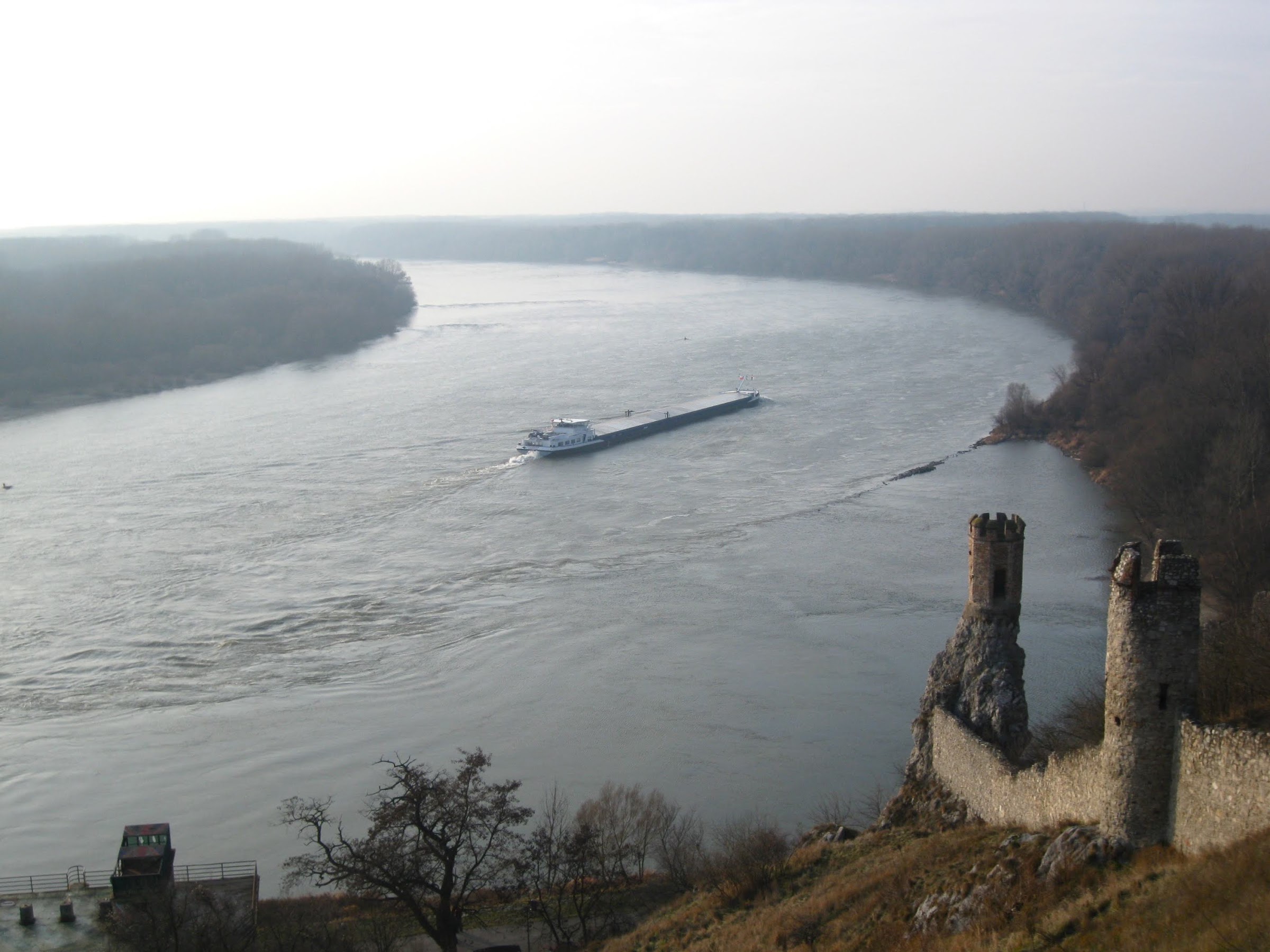
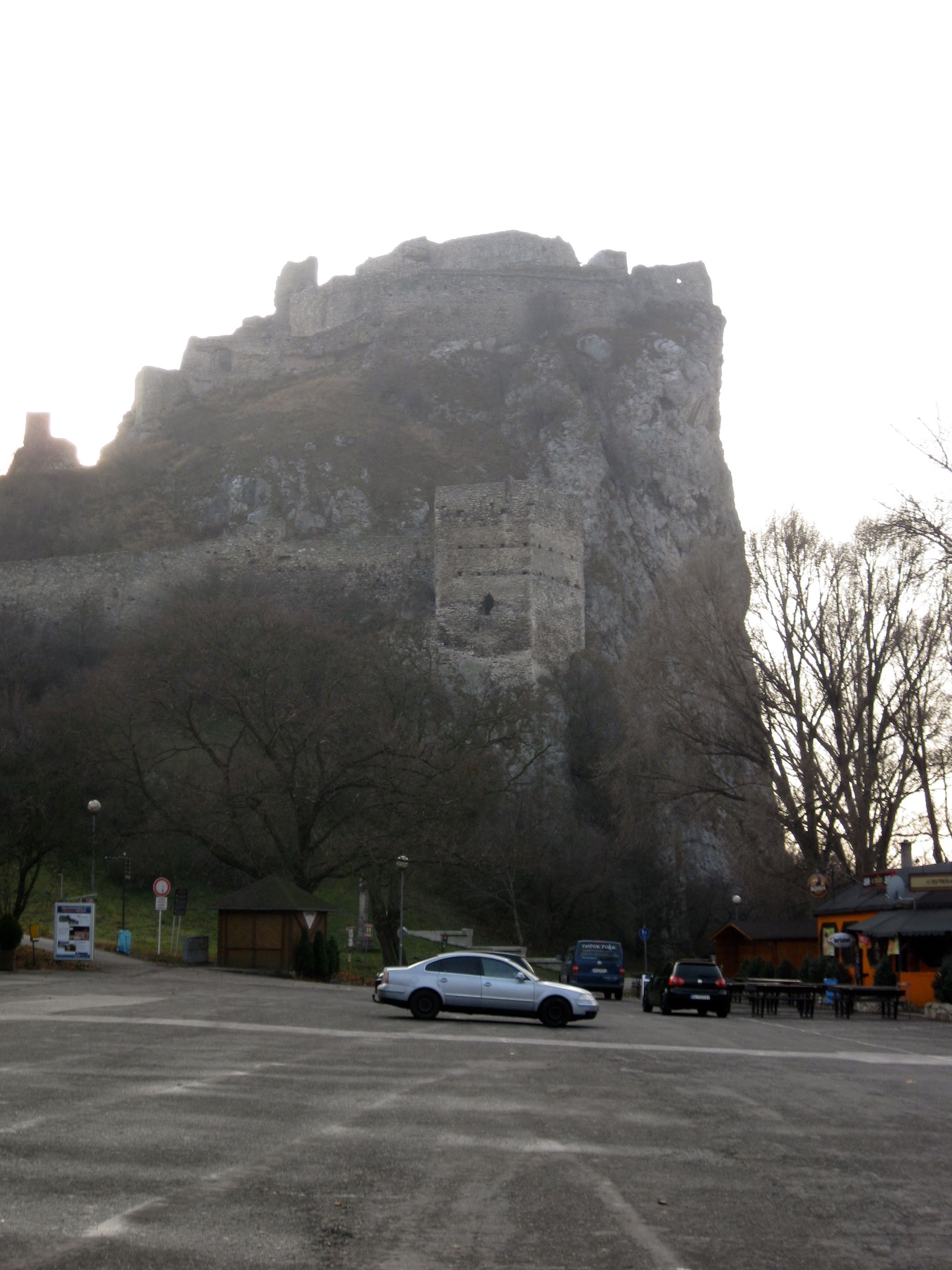
Slovakia is littered with castles, some in ruins, others in remarkably nice, well-preserved condition. We took the bus to Devin castle today, which is about 25 minutes west up the Danube from Bratislava's historical center. It's perched dramatically atop a jagged, rocky outcropping right at the confluence of the Morava and the Danube rivers, along the border with Austria.
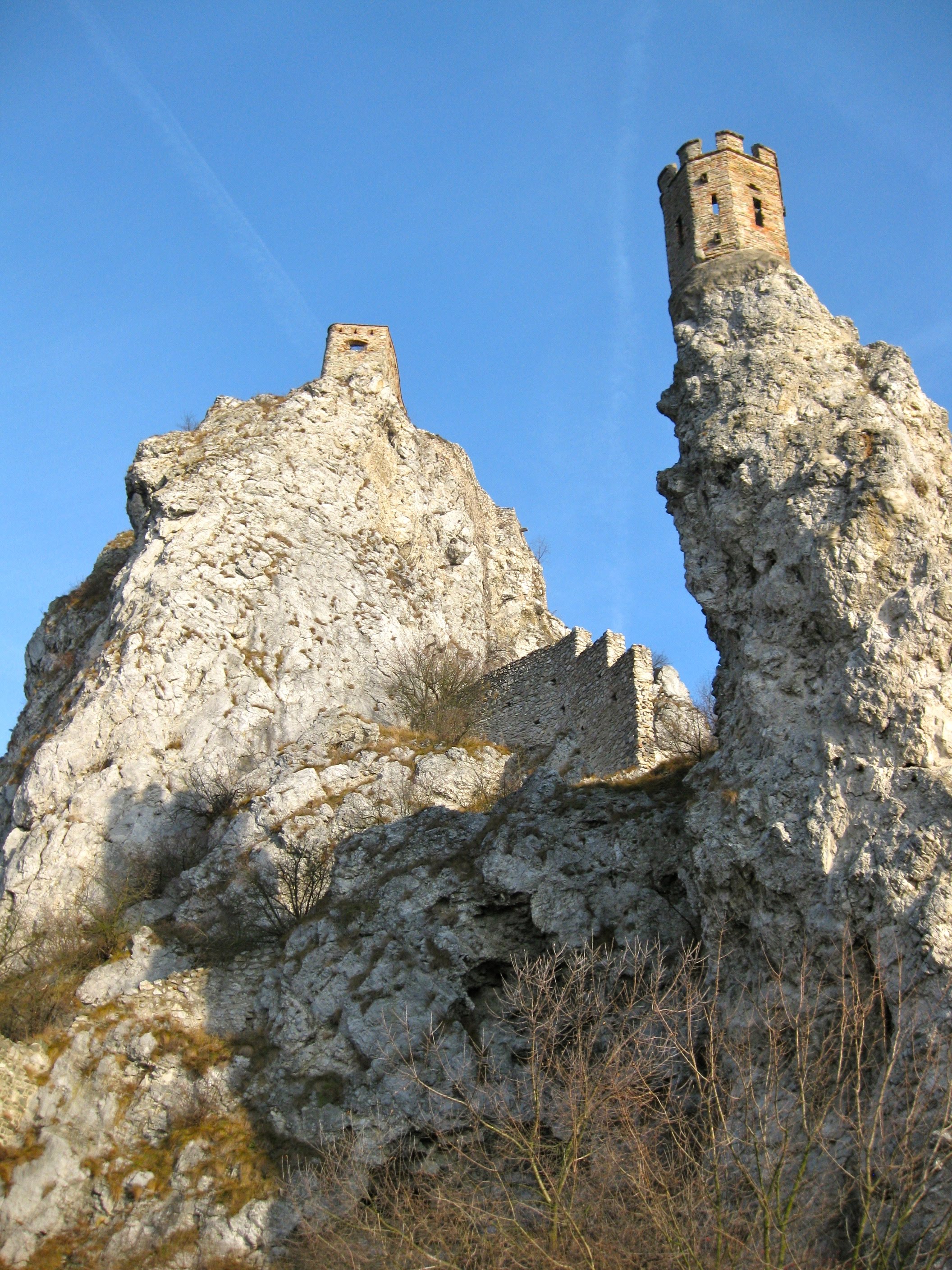
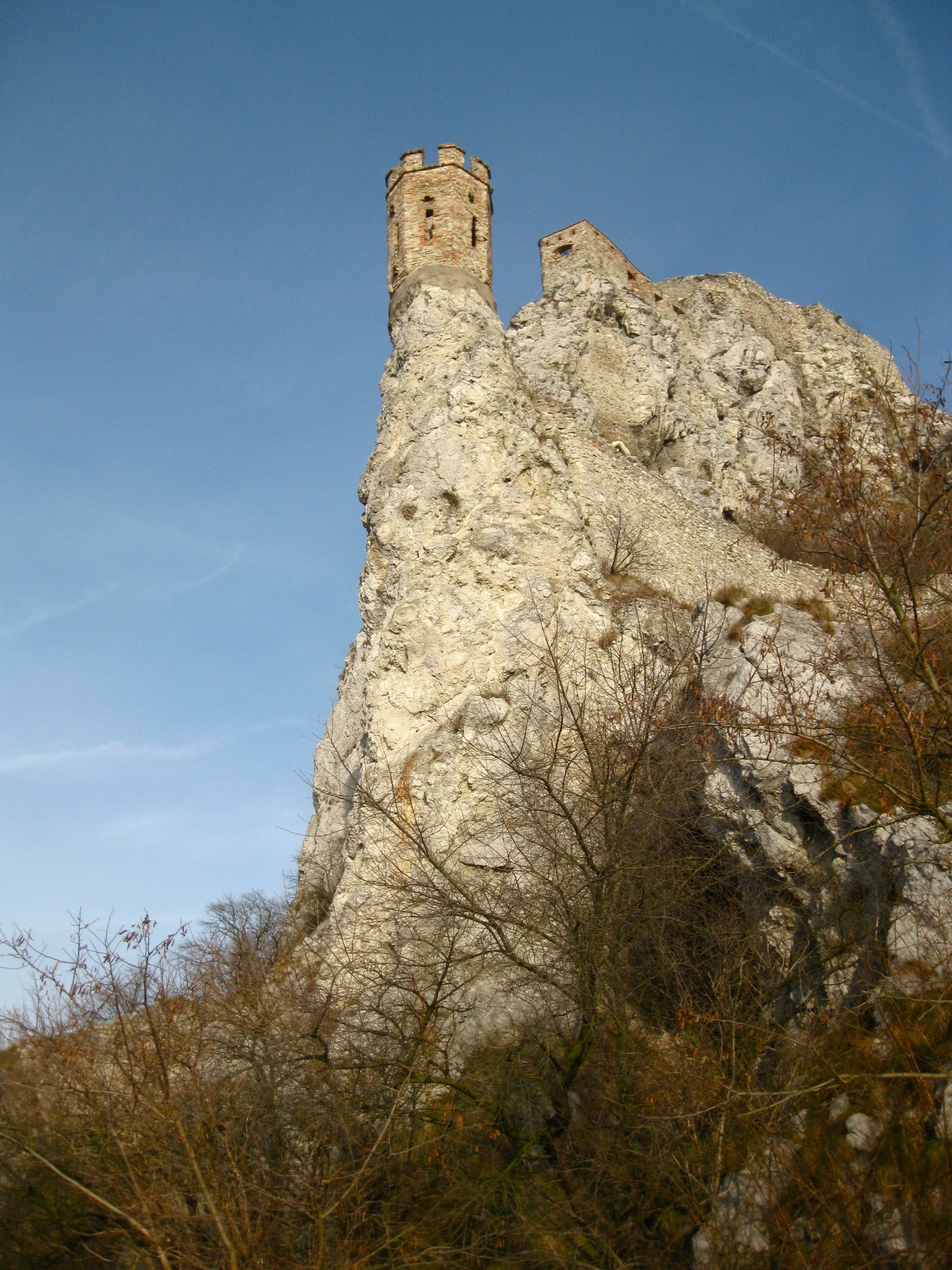
There were settlements on this spot as far back as the Stone Age, some of the ruins you see today date back to the Moravian empire (700s - 1000s, roughly), and there's even the foundation of something built much earlier by the Romans. Sadly, Napoleon blew the thing up in 1809, which is the reason for its current ruinous state.
The little crenellated tower that caps the arm-like outcropping that juts skyward is known as the Maiden Tower, and there are some colorful myths attached to it.
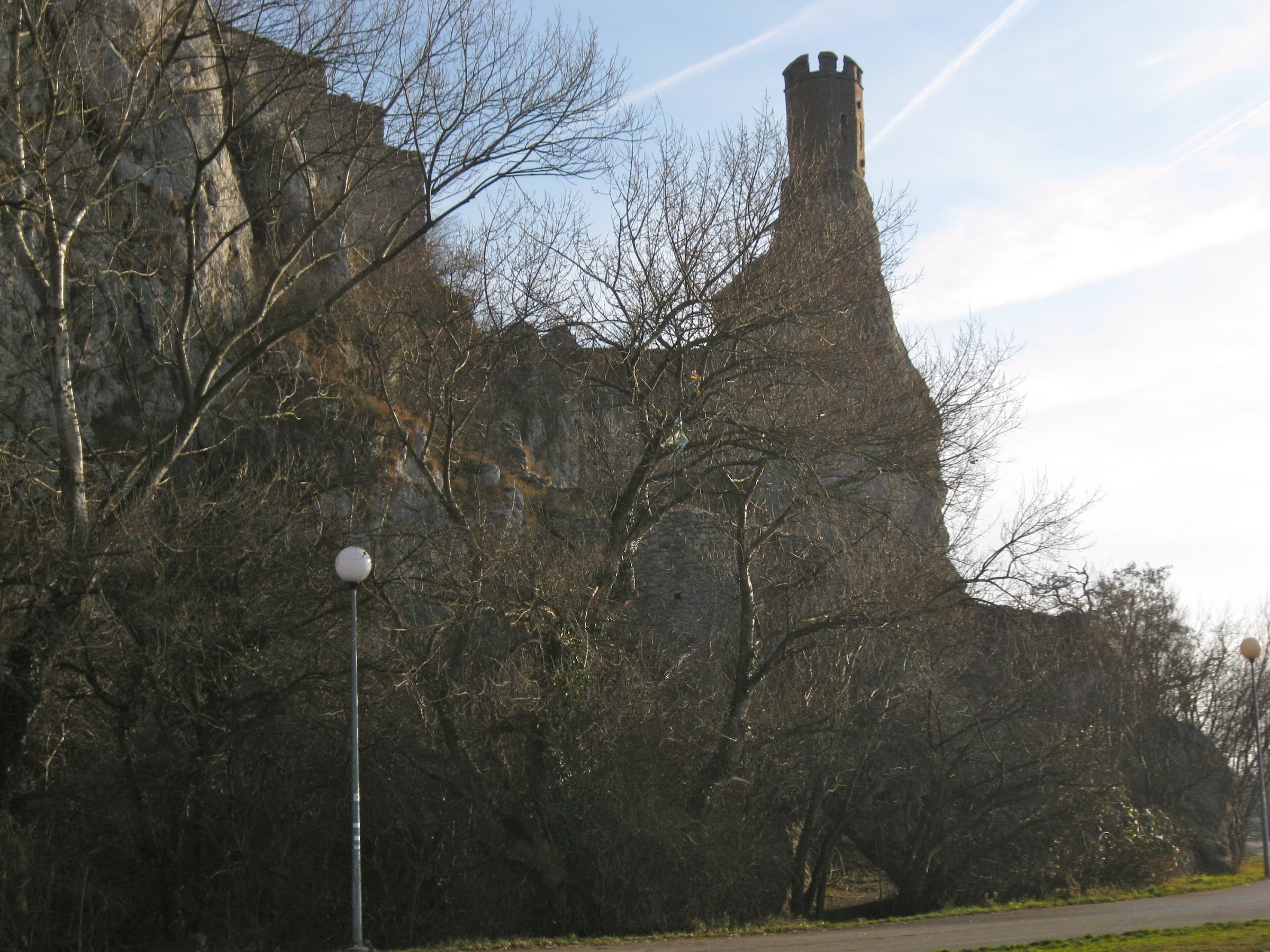
The views from the castle itself (of Austria, the Danube, the Morava, the village of Devin, etc.) are worth the climb, and there is a path that snakes its way up the hill to the castle ruins. Visually, the castle and its atmospheric setting are quite nice.
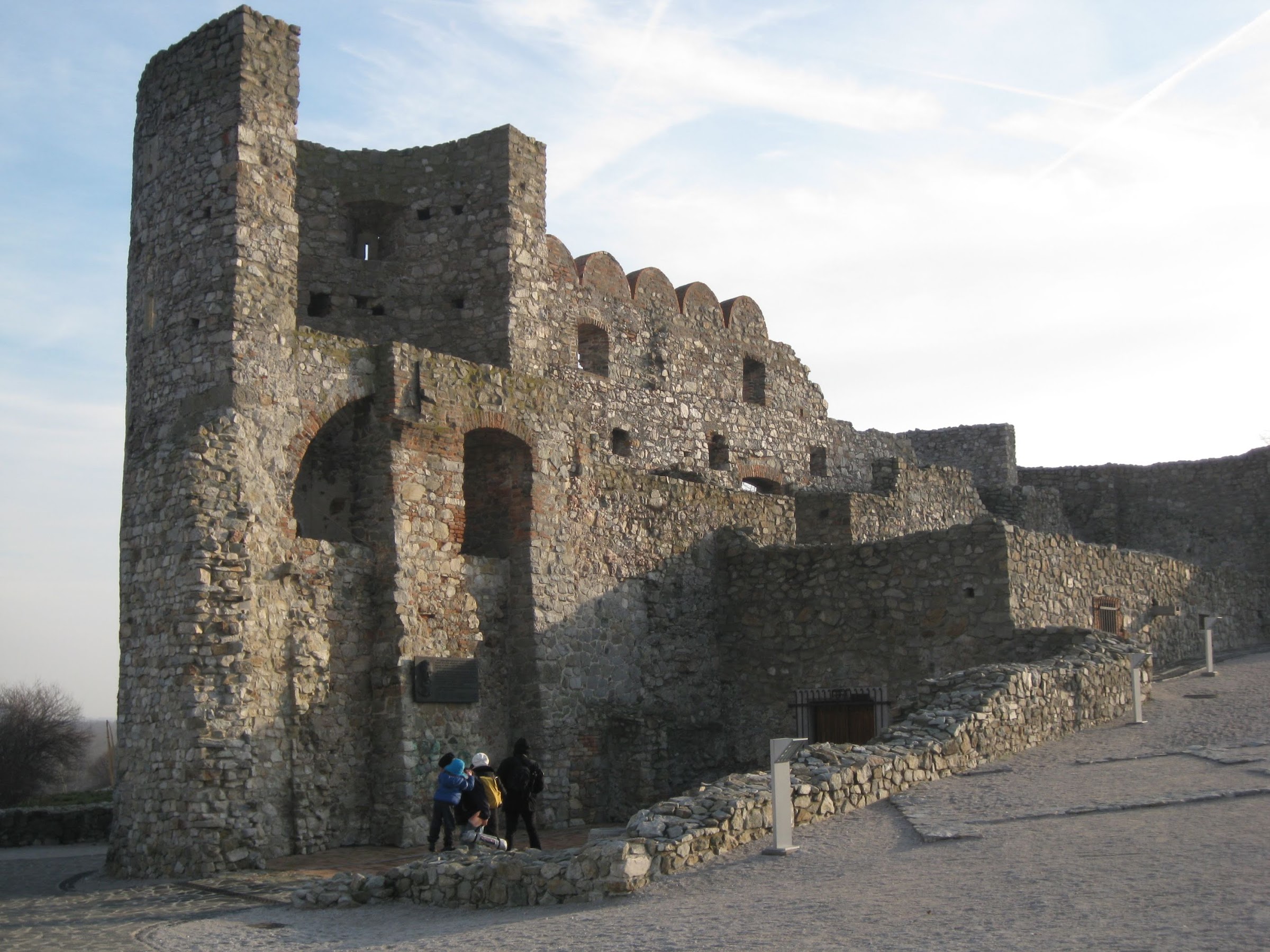
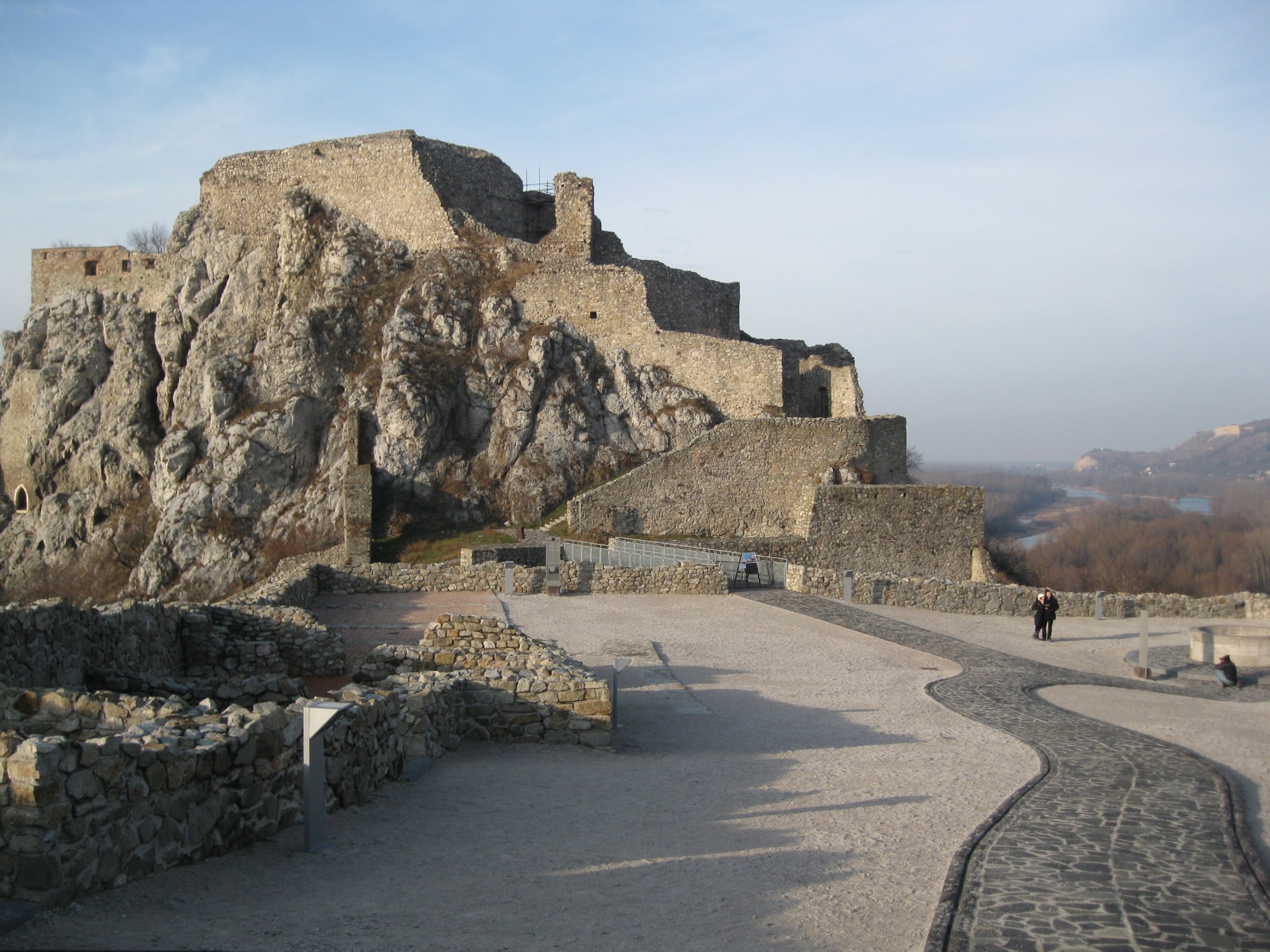
At the base of the castle is a monument to those who died trying to escape across the border to Austria during communism. An estimated 300 people were shot dead while attempting to flee. The monument is pockmarked with bullet holes to symbolize the tragic fate that befell these people. It's especially sobering to contemplate how this whole area along the border was a heavily guarded militarized zone during communism, which may be easy forget given how scenic and tranquil it is today.

Friday, December 30, 2011
Belated Christmas post: the walk to Starka's house
On Christmas we walked to Terezia's starka's (grandmother's) house for lunch. Terezia's starka lives in Tomasovce, which is the next village down from where her parents live, in Podrecany. You can walk between the villages via a dirt road that's used by farm tractors, which traverses some truly beautiful scenery (gently rolling hills, lush and tangled foliage, a meandering creek, etc.). In winter, when there's snow (even only a thin layer, as there was this year, which has been unusually warm) the path looks wonderfully atmospheric, and here are some photos to prove it.


Wednesday, December 28, 2011
Going in for my "scanning".
While well intentioned, setting the alarm for 5:00 am did not quite achieve the desired effect when confronted with the harsh reality of actually getting out of bed at such an ungodly hour. The snooze button was pushed once. Or twice. At any rate, we were out in the cold, still-dark city air and still-empty streets by five 'til 6:00, high-tailing it to the 1 line tram stop about a block away. Ten minutes later, after making the connection to the 83 bus to Petrzalka, we sat toward the back, half asleep, pondering pessimistically the length of the line that awaited us at our destination. In the pre-sun darkness, the quarter-full, articulated 83 bus charged and lurched through the pre-rush-hour streets like a dragon at the Chinese New Years parade. Although most of the passengers were wide-awake middle-aged women on their way to the early shift, there was a smattering of dozing, faux-hawked, eurotrash 20-somethings, and a couple of mustached middle-aged white collar types with papers rolled up under their arms.
We got off by the Albert grocery store and walked through the pseudo-park shortcut that cynical urban-planners 30+ years ago must've felt offset the surrounding forest of oppressively stark, concrete, monolithic residential high-rise buildings that make up Petrzalka. Once at our destination, we decided not to get too excited about the line being only about 20 strong this time, given past experiences where said line swelled in front of us by nearly half its size. And there we stood, in the cold and dark morning air, with Russians, Ukrainians, a cluster of Vietnamese, and other hopefuls, waiting for the iron-clad door of the Foreign Police to open. Naturally, the line swelled, much as it has in the past, when a gaggle of Russians and/or Ukrainians came sauntering up five minutes before opening. They met their pals or acquaintances who let them into the line ahead of us, or, just assumed they could get cuts from anyone speaking their language, none of them giving a damn about reinforcing deeply ingrained stereotypes that those of the non-Russian ilk harbor against them.
After what felt like an eternity, the line was allowed to filter in, each person grabbing the numbered tickets spat at them by the dirty waist-high machine sitting by the door. The warm, cramped, brightly lit room filled up fast while we made a B-line for the last two spots on the limited bench seating around the perimeter. And there we sat, waiting for the digital scoreboard overhead to tell us that our number was being called at Workstation 7 or 8. We had ticket #42, which helpfully mentioned that we had 10 people ahead of us. With each person generally taking about 15-20 minutes, it wasn't difficult to see that we'd be in it for the long haul that morning.
We sat. And waited. People filtered in and out. 80% of them Russian, or from those countries that were formerly part of the Soviet Union, like Ukraine, Moldova, etc. Why were they so desperate to get into Slovakia? Little Slovakia, perpetually overshadowed by its neighbors, and routinely (and wrongly) made to look like a complete shithole in more than one Hollywood flick? Slovakia, with double-digit unemployment and even a once-deeply entrenched Maffia that had seen better days back before its members had violently killed each other off? I suppose it just goes to show how much worse it is in Russia (and elsewhere further east). Perhaps more importantly, Slovakia is a gateway to the EU, and once inside the EU, the possibilities for workers of all kinds must seem comparatively limitless.
Somewhere around 10:30, after the room had gradually gone from being a zen-like test of one's patience to a mind-melting, foggy blur, the score board's irksome, synthetic two-note jingle sounded, and #42 flashed by Workstation 8. We walked into the office and were met by a woman in her late 20s/early 30s with almost a little too much makeup and lots of crimson dye streaking through her otherwise dark brown hair. Separated by a half-inch thick panel of clear glass, we gave her my passport and our reason for subjecting ourselves to this veritable plane of hell, and she went away for a couple of years to retrieve my file.
After returning, she motioned for me to go to the other side of the room where there was a small wooden chair. I sat down and messed with my hair, as I saw immediately that I was facing a camera which would take an image of my sleep-deprived mug for the Slovak equivalent of what would be my green card. As I locked eyes with the camera, its lens slowly zoomed out like a cyclops scrutinizing its victim, while crimson-dyed-hair woman fiddled with the buttons and wheel on her grime-encrusted computer mouse. I stared calmly into the lens and hoped for the best. Cameras in these places always have a humbling way of catching one's face in that split second where the muscles seem to spasm and the eyes tense up in a deeply unflattering manner.
Next I was instructed to place my hands on a warm machine that took my fingerprints. Little red dots over each finger turned green when it was satisfied with the pressure with which I applied. Once this was completed, we went back to the workstation where I was told we would receive a text message telling us when the card would be ready for pickup, and that we'd have to come back in and suffer Workstation 7 & 8's dreadfully Odysseyan lines yet again to retrieve it. Sure, they could probably just mail it, but this is all part of a test, you see, in which you prove just how badly you want to stay in this strange little country that Americans always seem to confuse with Slovenia. We were also told that I will have legal residency for five years. But that because my passport expires in 2015, so will my residency card, at which point I'll have to go back in and get a new card, which will be valid for the remainder of the five years.
In the meantime, I will go to a doctor who will take some of my blood in order to determine that I'm free of infectious diseases. Hopefully this will be done in a timely manner before I go to pick up my residency card, so I can kill two birds with that one proverbial stone. Sure, I've made my share of choices in the past that served to make life less pleasant, but I really want to avoid spending more mornings than I have to at the endurance-deyfing hell that is Slovakia's Foreign Police.
(To see photos I've recently taken in Bratislava, click here!)
Friday, December 23, 2011
An Xmas gift from Slovakia
We got the phone call this morning from the Foreign Police, saying that my file has been signed off and approved by the director. That means I can stay and I don't have to leave Slovakia on January 1, a prospect I'd been dreading for over a month now! That we managed to achieve this in such a short period of time is monumental. Like I've mentioned before, it usually takes the Foreign Police 90 days to grant a residency visa, from the time that you first submit your paperwork. And we managed to do this in just under a month. It definitely would not have happened had Terezia not been persistent about calling and pestering people, and pleading. Had we simply submitted the paperwork and sat around waiting for a response, I definitely would have to have gone back to the US, so being pro-active with these people really seems to help.
So, now we can actually enjoy our Christmas, and not sit around stressing out, wondering, hoping, dreading, etc.
We're not done with the Foreign Police yet. Next week I have to come in to get my ID card, and after that I'll have to go to a doctor and get a report that states that I have no infectious diseases. But that should all be a breeze.
At any rate, I hope the 1.5 people still reading this have a fabulous holiday. We'll be in Podrecany visiting the parents over the holiday weekend, but we'll be back next week.
(Click here to see photos I've recently taken in Bratislava)
Monday, December 19, 2011
The interview with the Foreign Police
As mentioned a couple posts ago, we were given an appointment for our interview with the Foreign Police, scheduled at the incredibly odd hour of 7:30 pm Sunday evening. All we needed to bring was someone who could translate for me. Tony couldn't do it because the translator must not be from Terezia's family, so he got a friend of his from work named Jaro to come along. We had no idea what to expect. When Terezia had a similar interview in the US for her green card, it took about five minutes and was basically a mere formality. We were also told by one of the people helping us at the Foreign Police that the interview here was similarly just a formality. The guy who told us that was clearly lying.
When we got there, we were greeted by our interviewer, a friendly woman who looked to be in her late 40s. She interviewed Terezia first while we waited outside in the hall. The interview took an hour and a half. A mere formality, right? I'm now totally convinced that the primary objective of Slovakia's Foreign Police is to test one's patience. At any rate, while the interviewer did remain friendly and personable, she really grilled Terezia, asking her about where we live, describing the layout and square footage; about when and how we met; about our wedding and who all attended; about hobbies, interests, and education; about each others' parents, etc. The whole interview dragged on and on. Luckily, Tony was sitting on a bench close to the office, and could hear through the door much of what was being said, so Jaro and I got a feel for what she'd be asking us.
When it was my turn, Jaro and I went in and sat down in two broken office chairs. The office was brightly lit and a dingy. Jaro did a good job translating, and the woman typed my responses into a Word template containing all the questions. I noticed right away that she was a horrible typist - she hunted and pecked with her index fingers. Getting this lady to a typing class would probably cut down the interview by half an hour, at least. I was asked the same questions as Terezia, but she apparently didn't need me to go into quite as much detail as Terezia provided. Despite dragging on for an eternity, it went well, and she said "dobre" ("good") after each of my responses, which was reassuring.
At the end, Jaro, quite thoughtfully, asked the woman about what would happen next, and whether there was any possibility that my residency permit would be approved before January 1. She told him that she will give the interview report to some other guy, and she can recommend that he approve it right away, but from there, it's kind of out of her hands. She said that she didn't foresee any problems with our case, and that it is possible that I can get the permit before January 1, but there are no guarantees. We basically need to keep calling and pestering these people until they give me the visa.
And we really can't thank Jaro enough for coming along and being my translator. That was incredibly nice of him to spend his Sunday evening in such a tedious way at such a dreadful place. He is an awesome guy, and we owe him big time!
(Click here to see photos I've taken this month)
Slaughtering a pig in Podrecany
So this weekend we went to visit Terezia's parents in Podrecany because her uncle Jano (who lives down the street) was slaughtering a pig. The pig slaughtering, or zabijacka, is an age-old tradition in Slovakia, whereby in early winter, many families take a pig that they've raised, kill it, and then make sausage and other pork items using just about every single part of the body. This tradition is kind of dying out these days, but you still see it done by families in more rural areas of the country. Terezia's family doesn't even do the zabijacka every year anymore (more like every few years), and in the past they used pigs that Terezia's grandfather raised himself, while this year they used a pig that Jano's son-in-law's parents raised. Nevertheless, ever since Terezia told me about this, I've had an intense and morbid curiosity about the whole thing. I brought along my trusty camera to document the process and spent the day getting my hands dirty (er, bloody) helping out.
Jano woke up super early in the morning to kill the pig. He reportedly shot it between the eyes and slit its throat, then brought the pig over from his son-in-law's parents' house from across the village in a truck.
When Terezia and I got to Jano's, it was about 7:30 in the morning. Jano shook my hand with his mud and pig-hair-encrusted hand, and offered me a shot of slivovice. Did I mention it was only 7:30 in the morning? At any rate, Jano, his son Janko, and son-in-law Marek had the pig lying on its side on wooden pallets and they were scraping off its hair with these metal cone-shaped implements.

Once they removed the hair, Jano took a blow-torch and browned the entire carcass. This softens the skin (and also removes any missed hairs) so that it's more tender and easier to slice through.


Next, they attached hooks to the pig's hind legs and hoisted it up with this contraption that you can see pictured here:

Jano sliced the pig's belly and collected the innards - intestines, bladder, kidneys, heart, lungs, stomach, etc. - in a large bucket. Next, they cut off the pig's head. Apparently it had a stronger-than-usual neck because Jano had to take a saw to its spinal chord, which is not normal. Then he and Janko cut out the spine, splitting the carcass in two. Next, they removed the skin, with its thick layers of fat, and detached the legs and the ribs.


The head was then split in half, and placed in a huge pot of boiling water along with the liver, heart, kidneys, and lungs, and cooked over a fire. We were nibbling on the lungs and cheeks, which were incredibly flavorful - like the taste of pork cranked up to 11.

The skin was brought to a table in the garage where we went to work separating it from the fat. We then cubed the fat, which was put in another large pot and slowly cooked over a fire to make lard and cracklings.

At some point, we took a lunch break and ate the pig's liver, which came in a rich sauce, and was eaten over mashed potatoes. The liver was mouthwateringly rich, flavorful, and tender.

Jano removed the meat from the legs to use for making sausage. We sliced the meat into manageable shapes so that it could be put through the meat grinder. Then Jano seasoned it with paprika, ground hot peppers, salt, and dried/crushed herbs. The mix was fed through the meat grinder again, but this time pushed into the sausage casing (made from intestine lining) via a tube affixed to the end of the grinder.


Next we made hurky, which is sausage made using dark meat from innards and the head, and then mixed with white rice. Some people also put the pig's blood in the hurky, making blood sausage, but for some reason Terezia's family doesn't do that. It's still good, though!

After making the hurky, we cleaned everything up, and, exhausted, we collapsed while waiting for Terezia's aunt, Elenka, to prepare some of the sausages. I'd been given shots of various types of hard alcohol roughly every half hour over the course of the entire day. While I wasn't snockered, I was a bit loopy, but mostly just wiped out from being on my feet for nine straight hours. On the whole, I'd say it was educational and fun. And while a lot of the visuals are definitely not for the faint-at-heart, at least the whole thing was more humane and less wasteful than what pigs experience in slaughter houses. It's a good way to really get to know the food you put on your plate! And I swear, if we were forced to live in some post-apocolyptic nightmare, these people would totally have the skills to live off the land and survive.
Jano woke up super early in the morning to kill the pig. He reportedly shot it between the eyes and slit its throat, then brought the pig over from his son-in-law's parents' house from across the village in a truck.
When Terezia and I got to Jano's, it was about 7:30 in the morning. Jano shook my hand with his mud and pig-hair-encrusted hand, and offered me a shot of slivovice. Did I mention it was only 7:30 in the morning? At any rate, Jano, his son Janko, and son-in-law Marek had the pig lying on its side on wooden pallets and they were scraping off its hair with these metal cone-shaped implements.

Once they removed the hair, Jano took a blow-torch and browned the entire carcass. This softens the skin (and also removes any missed hairs) so that it's more tender and easier to slice through.


Next, they attached hooks to the pig's hind legs and hoisted it up with this contraption that you can see pictured here:

Jano sliced the pig's belly and collected the innards - intestines, bladder, kidneys, heart, lungs, stomach, etc. - in a large bucket. Next, they cut off the pig's head. Apparently it had a stronger-than-usual neck because Jano had to take a saw to its spinal chord, which is not normal. Then he and Janko cut out the spine, splitting the carcass in two. Next, they removed the skin, with its thick layers of fat, and detached the legs and the ribs.


The head was then split in half, and placed in a huge pot of boiling water along with the liver, heart, kidneys, and lungs, and cooked over a fire. We were nibbling on the lungs and cheeks, which were incredibly flavorful - like the taste of pork cranked up to 11.

 |
| Terka's dad manning the pot full of innards. |

At some point, we took a lunch break and ate the pig's liver, which came in a rich sauce, and was eaten over mashed potatoes. The liver was mouthwateringly rich, flavorful, and tender.

Jano removed the meat from the legs to use for making sausage. We sliced the meat into manageable shapes so that it could be put through the meat grinder. Then Jano seasoned it with paprika, ground hot peppers, salt, and dried/crushed herbs. The mix was fed through the meat grinder again, but this time pushed into the sausage casing (made from intestine lining) via a tube affixed to the end of the grinder.

 |
| Terka's dad made this meat grinder. It saves a lot of time and energy. |


Next we made hurky, which is sausage made using dark meat from innards and the head, and then mixed with white rice. Some people also put the pig's blood in the hurky, making blood sausage, but for some reason Terezia's family doesn't do that. It's still good, though!

After making the hurky, we cleaned everything up, and, exhausted, we collapsed while waiting for Terezia's aunt, Elenka, to prepare some of the sausages. I'd been given shots of various types of hard alcohol roughly every half hour over the course of the entire day. While I wasn't snockered, I was a bit loopy, but mostly just wiped out from being on my feet for nine straight hours. On the whole, I'd say it was educational and fun. And while a lot of the visuals are definitely not for the faint-at-heart, at least the whole thing was more humane and less wasteful than what pigs experience in slaughter houses. It's a good way to really get to know the food you put on your plate! And I swear, if we were forced to live in some post-apocolyptic nightmare, these people would totally have the skills to live off the land and survive.
Subscribe to:
Posts (Atom)